“‘The supremacy of self-interest.’”
When did money become the language our crumbling republic speaks?
14 OCTOBER—I do not know what to think or do as Donald Trump proceeds flagrantly ahead with his various schemes to buy votes in advance of the 3 November midterm elections. So far I mourn—not for our president but for us, we over whom he presides, and for what has become of us.
How low Trump has taken America. Or, turning the point another way, how low has America sunk such that political bribery, like the indulgences the Roman Church sold during the High and Late Middle Ages, is simply how things work.
A month ago this week Trump promised every American adult a check for $5,000 if Republicans win enough votes to keep their majorities in the two houses of Congress. This was during that not-well-attended Republican Midterm Convention in Dallas—in itself a sign of the ruling party’s desperation.
A couple of weeks ago Trump started sending $500 checks to roughly a million people getting health insurance via the Affordable Care Act. These are “refunds” for what Trump says are overcharges imposed during the Biden years. A couple of days later he announced a plan to send $90 checks to more than 20 million people to help with their monthly Medicare payments.
It goes on. At a political rally in Nebraska last week he made a great display of signing one of his countless executive orders at the podium—this authorizing tax-free diesel fuel for farmers and building contractors.
The other day I noticed the Social Security Administration deposited $252 directly into my bank account. So far as I can make out—and the S.S.A. offers no explanation—this reflected some kind of recalculation of my benefits. But a month before the midterms and amid all this other largesse the Trump regime authorizes? At the very least I have to question whether this is an attempt to buy my vote. (Wasted money in such a case: There is no vote to buy.)
Nobody is hiding anything here. Trump is altogether out of the closet as to what he is doing. “If the Republicans win, you win with us and you get $5,000,” he said at the Dallas convention. “It will be called the Trump dividend.” After signing the exec order authorizing tax-free diesel, he addressed Nebraska’s Republican senator and governor with this: “Pete and Jim, this should absolutely ensure your election. I guarantee you that.”
Trump, the Manhattan property predator, has long turned to payouts as his method of first resort when seeking public approval. It was he who sent out the first round of stimulus checks when the Covid–19 virus hit. That was in the spring of 2020. At the end of his first year back in office he sent checks for $1,776 to those serving in the military—his “warrior dividend,” as he called this.
Money as the common denominator among Americans, the language of our crumbling republic, is a foregone conclusion for the Trumpster. I mourn not for Trump but as I note how many Americans speak it. How much do people care about the criminal conduct of the American imperium as against the price of gasoline at the local service station? Which is likely to get any given American off his or her sofa?
The last presidents to appeal to Americans with ideals to live by, or ideas to be considered, or their responsibilities to each other and to others, or simply a shared concern for the commonweal were Kennedy and Carter. The one was assassinated for his admirable vision—this was precisely the case—and the other was pushed humiliatingly out of office because, post–Vietnam, he distinguished in broad daylight between right and wrong and told Americans they could do better than they had done to date.
All thought of American ideals evaporated pretty quickly in the post–Carter years. Reagan pretended to some—“shining City on a Hill,” “morning in America,” etc.—but that was mere cover: He didn’t actually have any. Freedom, which Reagan spoke of incessantly, had nothing to do with human liberation: It meant the free markets and the freedom to maximize profits whatever the costs to others, the environment, or any such consideration.
Bush I, Clinton, Bush II: It was during these regimes that the Chicago School triumphed and self-interest became the ruling ideology. Remember “rational choice theory,” the thought that what people will do in any given situation is reliably dictated by what serves them as individuals? That was the work of Milton Friedman, Gary Becker, et al., who made a point of perverting Adam Smith’s writings for the sake of some intellectual ballast.
From self-interest as a legitimate ethos to money and profit as the only “values” Americans live by is not a long leap—not, especially, when the rise of self-interest as a philosophic construct coincides with the creeping impoverishment of the nation’s working and middle classes in the post–Carter decades.
Barack Obama and Joe Biden: Their regimes did nothing to reverse this national slide into chicken-scratching, however great their pretenses in this line. Biden and his corrupt family were, indeed, eager participants. And so to Trump.
Last weekend Trump held another of his pre-election rallies, this one in Clarksville, Tennessee. A photograph accompanying The New York Times’s report caught my eye. All those blank, uplifted faces looking toward Trump on the podium, with their outsized “47” baseball caps and banners reading “Tennessee Is Trump Country” behind them.
My mind when to a passage in Tradition of Freedom, a properly anti–American invective the idiosyncratic Georges Bernanos published after the Second World War:
The Dictator is not a leader. He is an emanation, a creation of the Masses. He is the incarnation of the Masses, he is the Masses at their highest potential of evil.
The highest potential of evil: How well the French writer’s phrase suits our time in America, for I count self-interest the ever-echoing evil that besets us. And what is Trump if not the very embodiment of this, self-interest made flesh? This, I finally come to realize, is why all those people in Clarksville, and the MAGA contingent across the country, stay with Trump no matter how atrociously he abuses them.
Chris Hedges conducted a lengthy interview last month with Susan Neiman, whose Call It Evil: Understanding the Trump Era (W.W. Norton) has just come out. I vigorously disapprove of what I read to be Neiman’s Zionist sympathies, but let us set this aside. She could scarcely have written more cogently on self-interest as the fundamental evil of our time.
Hedges published his exchange with Neiman under the headline, “Our Moral Decay,” and it is here in video and transcript. From it:
Trump and his coterie of Christian fascists, billionaires, grifters, and incompetents could not have come to power without a moral collapse in American society. It is not malice, but vacancy that marks the worst form of evil once the supremacy of self-interest is enshrined as a common sense realism rather than a philosophical idea. Moral capacities like empathy and shame become not just naive but suspect. Sadists exist and cause no end of pain, but the most common forms of evil arise from the view that only fools believe in anything but their own advantage.
Could Trump’s pecuniary appeals to voters express more plainly “the supremacy of self-interest,” as Susan Neiman so finely puts it? His regime is the end-point of the Age of Materialism, to view our place in history’s longue durée. Technological progress is the only kind the West has mastered these past 150 years, and money and profit were inevitably to be the measure of all the advances. The paradox here is that the idolatry of money and profit renders Americans incapable of making decisions on any other basis. This has produced—and Trump is Exhibit A—a politics of compulsion. Right or wrong, good for humanity or bad: None of this matters so long as there is the promise of material gain.
Artificial intelligence is a ready-to-hand case in point. Those running the big A.I. developers may entertain all sorts of otherworldly delusions of grandeur, but it is the money to be made that threatens to make an A.I.–everywhere future “inevitable,” as these people like to assert. This is why Trump, as you will have noticed, is full tilt for unregulated, more or less unscrutinized advances in A.I. It seems safe to assume he knows little about A.I. other than how profitable it is and will be.
There are the people who object to the risks of A.I. development. These are many, to state the obvious. Implicit in these objections is that there are values other than money and profit. This is the case that must be made. It is a question of going forward other than compulsively. It is a question of understanding that the ideology of self-interest—another paradox—is not in people’s interest any more than is money in politics.
Trump is indeed an emanation, to use Georges Bernanos’s word. He did not descend upon the people over whom he presides: He arose from among them. Kennedy and others like him in history: They were emanations, too, let us not forget.
When did money become the language our crumbling republic speaks?
14 OCTOBER—I do not know what to think or do as Donald Trump proceeds flagrantly ahead with his various schemes to buy votes in advance of the 3 November midterm elections. So far I mourn—not for our president but for us, we over whom he presides, and for what has become of us.
How low Trump has taken America. Or, turning the point another way, how low has America sunk such that political bribery, like the indulgences the Roman Church sold during the High and Late Middle Ages, is simply how things work.
A month ago this week Trump promised every American adult a check for $5,000 if Republicans win enough votes to keep their majorities in the two houses of Congress. This was during that not-well-attended Republican Midterm Convention in Dallas—in itself a sign of the ruling party’s desperation.
A couple of weeks ago Trump started sending $500 checks to roughly a million people getting health insurance via the Affordable Care Act. These are “refunds” for what Trump says are overcharges imposed during the Biden years. A couple of days later he announced a plan to send $90 checks to more than 20 million people to help with their monthly Medicare payments.
It goes on. At a political rally in Nebraska last week he made a great display of signing one of his countless executive orders at the podium—this authorizing tax-free diesel fuel for farmers and building contractors.
The other day I noticed the Social Security Administration deposited $252 directly into my bank account. So far as I can make out—and the S.S.A. offers no explanation—this reflected some kind of recalculation of my benefits. But a month before the midterms and amid all this other largesse the Trump regime authorizes? At the very least I have to question whether this is an attempt to buy my vote. (Wasted money in such a case: There is no vote to buy.)
Nobody is hiding anything here. Trump is altogether out of the closet as to what he is doing. “If the Republicans win, you win with us and you get $5,000,” he said at the Dallas convention. “It will be called the Trump dividend.” After signing the exec order authorizing tax-free diesel, he addressed Nebraska’s Republican senator and governor with this: “Pete and Jim, this should absolutely ensure your election. I guarantee you that.”
Trump, the Manhattan property predator, has long turned to payouts as his method of first resort when seeking public approval. It was he who sent out the first round of stimulus checks when the Covid–19 virus hit. That was in the spring of 2020. At the end of his first year back in office he sent checks for $1,776 to those serving in the military—his “warrior dividend,” as he called this.
Money as the common denominator among Americans, the language of our crumbling republic, is a foregone conclusion for the Trumpster. I mourn not for Trump but as I note how many Americans speak it. How much do people care about the criminal conduct of the American imperium as against the price of gasoline at the local service station? Which is likely to get any given American off his or her sofa?
The last presidents to appeal to Americans with ideals to live by, or ideas to be considered, or their responsibilities to each other and to others, or simply a shared concern for the commonweal were Kennedy and Carter. The one was assassinated for his admirable vision—this was precisely the case—and the other was pushed humiliatingly out of office because, post–Vietnam, he distinguished in broad daylight between right and wrong and told Americans they could do better than they had done to date.
All thought of American ideals evaporated pretty quickly in the post–Carter years. Reagan pretended to some—“shining City on a Hill,” “morning in America,” etc.—but that was mere cover: He didn’t actually have any. Freedom, which Reagan spoke of incessantly, had nothing to do with human liberation: It meant the free markets and the freedom to maximize profits whatever the costs to others, the environment, or any such consideration.
Bush I, Clinton, Bush II: It was during these regimes that the Chicago School triumphed and self-interest became the ruling ideology. Remember “rational choice theory,” the thought that what people will do in any given situation is reliably dictated by what serves them as individuals? That was the work of Milton Friedman, Gary Becker, et al., who made a point of perverting Adam Smith’s writings for the sake of some intellectual ballast.
From self-interest as a legitimate ethos to money and profit as the only “values” Americans live by is not a long leap—not, especially, when the rise of self-interest as a philosophic construct coincides with the creeping impoverishment of the nation’s working and middle classes in the post–Carter decades.
Barack Obama and Joe Biden: Their regimes did nothing to reverse this national slide into chicken-scratching, however great their pretenses in this line. Biden and his corrupt family were, indeed, eager participants. And so to Trump.
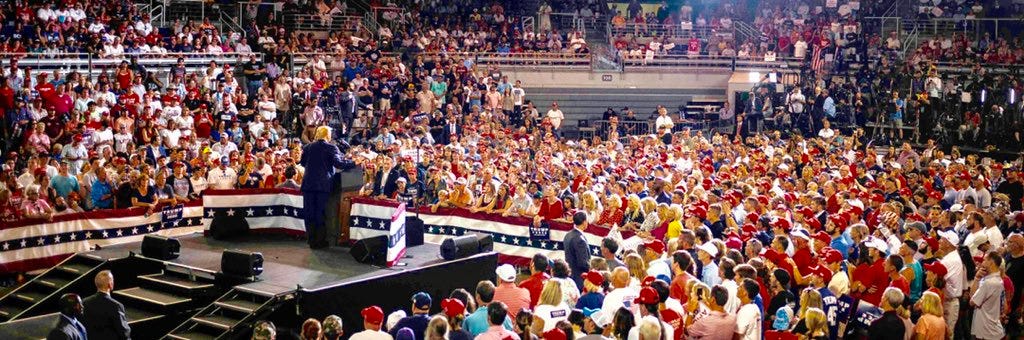
Last weekend Trump held another of his pre-election rallies, this one in Clarksville, Tennessee. A photograph accompanying The New York Times’s report caught my eye. All those blank, uplifted faces looking toward Trump on the podium, with their outsized “47” baseball caps and banners reading “Tennessee Is Trump Country” behind them.
My mind when to a passage in Tradition of Freedom, a properly anti–American invective the idiosyncratic Georges Bernanos published after the Second World War:
The Dictator is not a leader. He is an emanation, a creation of the Masses. He is the incarnation of the Masses, he is the Masses at their highest potential of evil.
The highest potential of evil: How well the French writer’s phrase suits our time in America, for I count self-interest the ever-echoing evil that besets us. And what is Trump if not the very embodiment of this, self-interest made flesh? This, I finally come to realize, is why all those people in Clarksville, and the MAGA contingent across the country, stay with Trump no matter how atrociously he abuses them.
Chris Hedges conducted a lengthy interview last month with Susan Neiman, whose Call It Evil: Understanding the Trump Era (W.W. Norton) has just come out. I vigorously disapprove of what I read to be Neiman’s Zionist sympathies, but let us set this aside. She could scarcely have written more cogently on self-interest as the fundamental evil of our time.
Hedges published his exchange with Neiman under the headline, “Our Moral Decay,” and it is here in video and transcript. From it:
Trump and his coterie of Christian fascists, billionaires, grifters, and incompetents could not have come to power without a moral collapse in American society. It is not malice, but vacancy that marks the worst form of evil once the supremacy of self-interest is enshrined as a common sense realism rather than a philosophical idea. Moral capacities like empathy and shame become not just naive but suspect. Sadists exist and cause no end of pain, but the most common forms of evil arise from the view that only fools believe in anything but their own advantage.
Could Trump’s pecuniary appeals to voters express more plainly “the supremacy of self-interest,” as Susan Neiman so finely puts it? His regime is the end-point of the Age of Materialism, to view our place in history’s longue durée. Technological progress is the only kind the West has mastered these past 150 years, and money and profit were inevitably to be the measure of all the advances. The paradox here is that the idolatry of money and profit renders Americans incapable of making decisions on any other basis. This has produced—and Trump is Exhibit A—a politics of compulsion. Right or wrong, good for humanity or bad: None of this matters so long as there is the promise of material gain.
Artificial intelligence is a ready-to-hand case in point. Those running the big A.I. developers may entertain all sorts of otherworldly delusions of grandeur, but it is the money to be made that threatens to make an A.I.–everywhere future “inevitable,” as these people like to assert. This is why Trump, as you will have noticed, is full tilt for unregulated, more or less unscrutinized advances in A.I. It seems safe to assume he knows little about A.I. other than how profitable it is and will be.
There are the people who object to the risks of A.I. development. These are many, to state the obvious. Implicit in these objections is that there are values other than money and profit. This is the case that must be made. It is a question of going forward other than compulsively. It is a question of understanding that the ideology of self-interest—another paradox—is not in people’s interest any more than is money in politics.
Trump is indeed an emanation, to use Georges Bernanos’s word. He did not descend upon the people over whom he presides: He arose from among them. Kennedy and others like him in history: They were emanations, too, let us not forget.