What Would Ronny Do?
Ostensible “Reagan Republicans” like to say that the iconic conservative American President would be rolling in his grave over Trump’s “abandonment” of Ukraine. They are wrong.
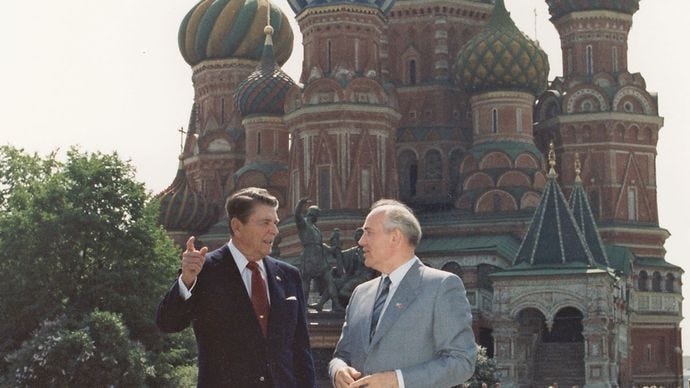
There is a host of self-proclaimed “Reaganites” (i.e., those conservative Republicans who embraced the leadership and values of Ronald Reagan, the iconic conservative American President whose 8-year term in office defined the decade of the 1980’s and helped end the Cold War he once embraced) who decry the efforts of the current American President, Donald Trump, to find a pathway to peace with Russia today. “Reagan would be rolling over in his grave”, these erstwhile supporters of life, liberty and the American way proclaim.
They are half correct.
Reagan would be rolling over in his grave today.
But not because of any effort by the Trump administration to make peace with Russia in an effort to avoid a nuclear Armageddon.
No, Reagan would be tossing and turning (if such a thing were possible) because of the Russophobic policies being promoted in his name which are propelling the United States down the very path of nuclear war with Russia that Reagan had so deftly exited at the end of his second term.
There was a time when Ronald Reagan decried the Soviet Union as the “Evil Empire”, and joked about nuclear missiles flying toward Russia.
Fact-free ideology, however, collapses in the face of fact-fueled reality, however, and by the end of Reagan’s first term in office the hardline Cold Warrior, confronted with the looming probability of a nuclear war with the Soviet Union that would end all life on the planet, took his country down a different path.
A path of peace and reconciliation with the Soviet Union.
A path that led to the elimination of an entire class of nuclear weapons which threatened Europe with imminent destruction.
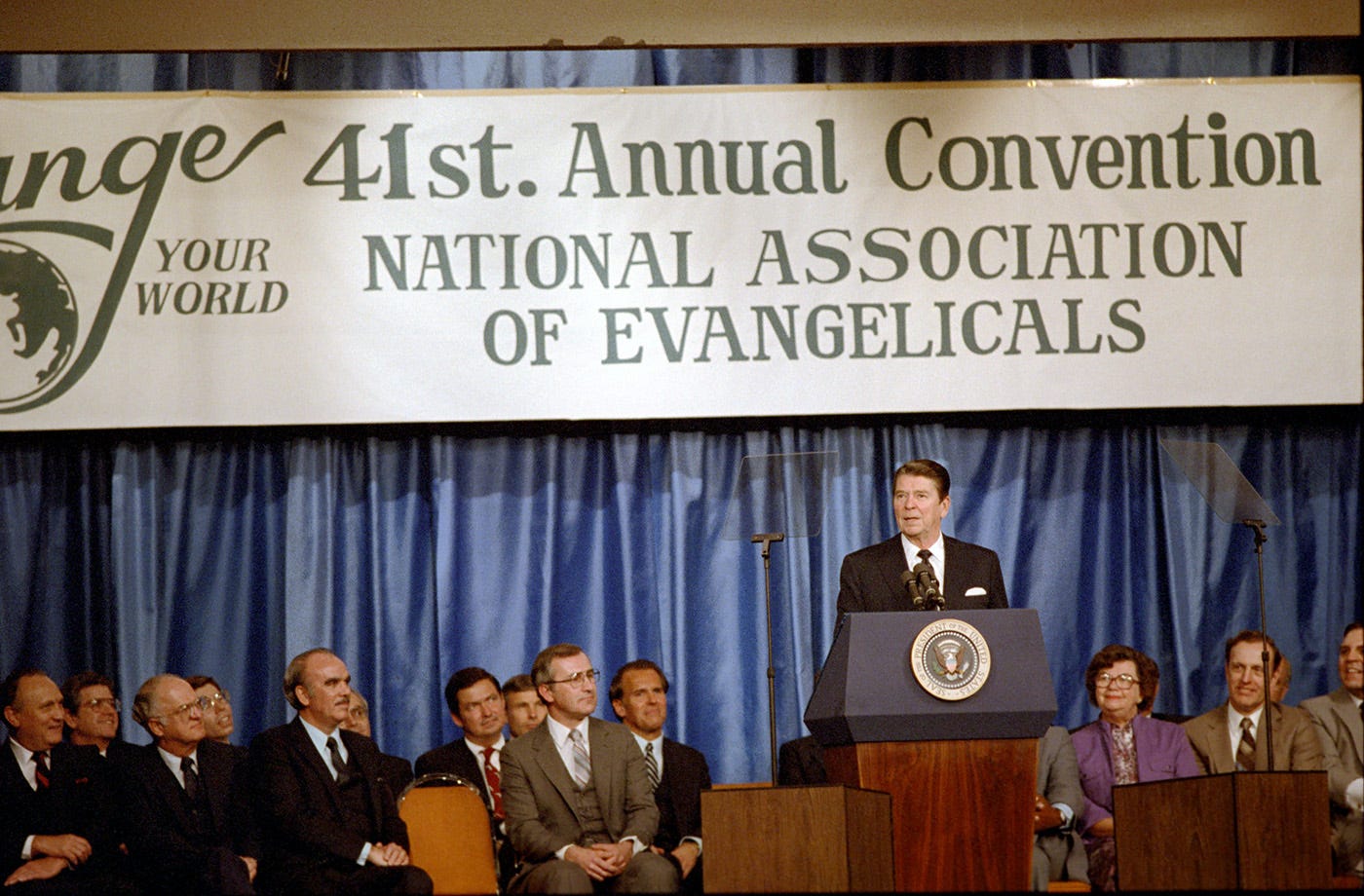
To better understand this journey, and why American conservatives today fail to understand the real meaning of the final manifestation of Reagan conservatism, one must go the source of the rhetorical flourish which gave birth to the notion of an “Evil Empire” resident on the soil of Russia—Reagan’s speech in Orlando, Florida, on Match 8, 1983, to the National Association of Evangelicals.
“During my first press conference as president,” Reagan told the assembled crowd, “in answer to a direct question, I pointed out that, as good Marxist-Leninists, the Soviet leaders have openly and publicly declared that the only morality they recognize is that which will further their cause, which is world revolution. I think I should point out I was only quoting Lenin, their guiding spirit, who said in 1920 that they repudiate all morality that proceeds from supernatural idea—that’s their name for religion—or ideas that are outside class conceptions. Morality is entirely subordinate to the interests of class war. And everything is moral that is necessary for the annihilation of the old exploiting social order and for uniting the proletariat.”
Reagan continued. “I urge you to beware the temptation of pride—the temptation of blithely declaring yourselves above it all and label both sides equally at fault, to ignore the facts of history and the aggressive impulses of an evil empire, to simply call the arms race a giant misunderstanding and thereby remove yourself from the struggle between right and wrong and good and evil.”
It was this line gave gave birth to the “Evil Empire” fetish that seized the imagination of many conservatives then, and continues to do so to this day. But the foundation of the reasoning behind the embrace of the label “evil” had nothing to to with Russia or being Russian, but rather in the ideology of two Germans—Marx and Engel—which was embraced by a generation of primarily Jewish atheists and used to fuel a revolution fueled by decades of social division inside the Russian Empire. It was communism, not Russia, which sustained the “evil” characterization Reagan gave rise to in his speech.
“I believe that communism is another sad, bizarre chapter in human history whose last pages even now are being written,” Reagan concluded in his speech. “I believe this because the source of our strength in the quest for human freedom is not material, but spiritual. And because it knows no limitation, it must terrify and ultimately triumph over those who would enslave their fellow man. For in the words of Isaiah: ‘He giveth power to the faint; and to them that have no…might He increased strength. But they that wait upon the Lord shall renew their strength; they shall mount up with wings as eagles; they shall run, and not be weary.’”
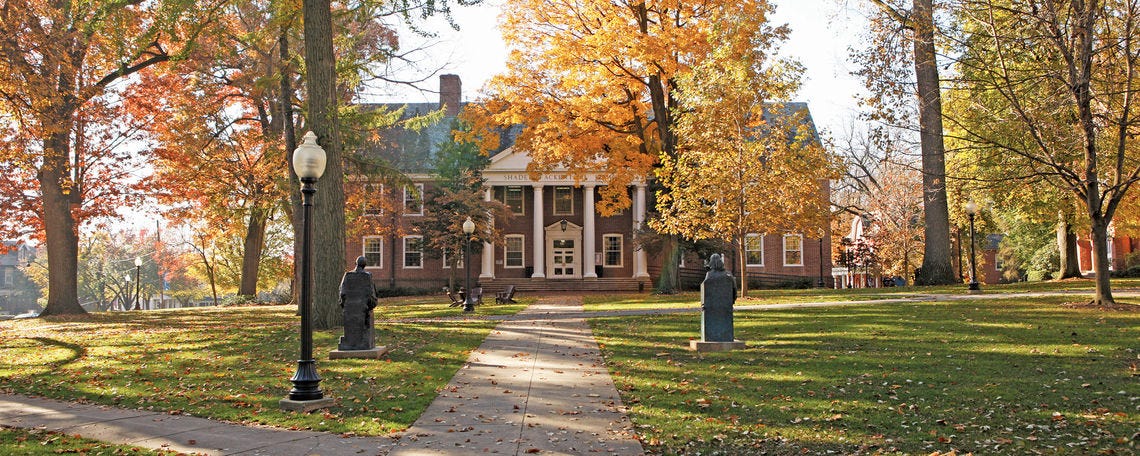
In March 1983 I was midway through the final semester of my Junior year at Franklin and Marshall College. I was a Russian history major, and was enrolled in a number of courses, including Marxist Economy and Communism 101, which furthered the understanding I was developing about Russia and the Soviet Union I had garnered after nearly three years of studying the History of the Russian Revolution, An Architectural History of Saint Petersburg, The Cold War, Dostoevsky, and The Cuban Missile Crisis, among others.
I had decided on the study of Russia as my chosen academic priority because of a larger career choice I had already embarked on—to serve as a commissioned officer in the United States Marine Corps so I could protect my country, its people, and its values from the scourge of communism. I had grown up a child of the Cold War, the son of a career Air Force officer. I grew up on Air Force bases where the sounds of F-106 Delta Dart fighter aircraft rising into the sky to intercept incoming Soviet bombers—real and imagined—was a constant reality.
In Hawaii, where the aircraft involved were the older F-102 fighters, I personally experienced the harsh reality of the Vietnam War as an extension of this fight against communism. My father constantly deployed to South Vietnam, where he helped oversee the “Vietnamization” of the air war against communist North Vietnam (this after serving a tour in Vietnam as an aircraft maintenance office with the 10th Fighter Commando squadron—the famous “Skoshi Tigers”—in 1966-67.) He lost friends during that deployment. Later, in 1973, when the US participation in the conflict came to an end, I stood on the tarmac welcoming back home American prisoners of war who had been tortured by the communists. And after Saigon fell in April 1975, my family took in a family of South Vietnamese refugees who fled fearing for their lives as the communists took over.
I was conditioned from an early age to hate communism.
My father’s subsequent tours of duty in Turkey and West Germany—both frontline nations in the Cold War against the communists who ruled over the Soviet Union. In Turkey, I would often go to the Black Sea and stare across the expanse of water, imagining life behind the Iron Curtain. And while in West Germany I had the opportunity to visit West Berlin on several occasions where, in the conduct of my transit via rail and motorway, I came face to face with the Soviet enemy at the various checkpoints that had to be navigated in order to complete these journeys. Checkpoint Charlie, in the center of the city, was an experience that sent chills down one’s spine—staring across the “no mans land” into communist territory, watching the armed soldiers of communism staring back at you.
Life in West Germany was punctuated by the constant presence of military trucks, tanks, and other assorted vehicles filling the roads and highways, while helicopters hovered over the tree lines and jet fighters screamed overhead. I lived with the dual reality that the village I lived in was on the main axis of advance for the Soviet armies poised across the border in East Germany and Czechoslovakia, and that this very same village was collocated to a US nuclear weapons storage facility so that in the case of war my most likely fate would be to be killed in the opening salvo of communist nuclear weapons dispatched to destroy this site and its weapons.
I didn’t fear communism.
I hated it.
In his speech to the evangelicals, Reagan said something that resonated deeply within me. “A number of years ago,” he said, “I heard a young father, a very prominent young man in the entertainment world, addressing a tremendous gathering in California. It was during the time of the cold war, and communism and our own way of life were very much on people’s minds. And he was speaking to that subject. And suddenly, though, I heard him saying, ‘I love my little girls more than anything."‘ And I said to myself, ‘Oh, no, don’t. You can’t—don’t say that.’ But I had underestimated him. He went on: ‘I would rather see my little girls die now; still believing in God, than have them grow up under communism and one day die no longer believing in God.’”
“Better Dead than Red” was not some silly throw-away slogan.
It was a way of life—my life. That was my ethos, built upon a childhood filled with emotional, physical and visual stimuli that constantly reinforced this belief.
It defined my college experience.
And it defined who I was after graduating from college—a dyed-in-the-wool anti-communist, dedicated to giving my life in defense of my nation and its values.
I was the living, breathing manifestation of what a true “Reagan Republican” stood for, at least from a foreign policy and national security perspective (like most military professionals, I eschewed domestic politics.)
I spent the time period between November 1984—when I reported to The Basic School in Quantico, Virginia as a newly-minted Second Lieutenant, and January 1988, when I left the Marine Corps Air-Ground Combat Center, 29 Palms, California, training to go to war with the Soviet Union. This was an all-immersive experience, dominating every aspect of my life and facet of my existence. My background as a Russian historian helped get me my military occupation specialty as an intelligence officer, and in this role I poured myself into the mission of closing with and destroying the communist enemy.
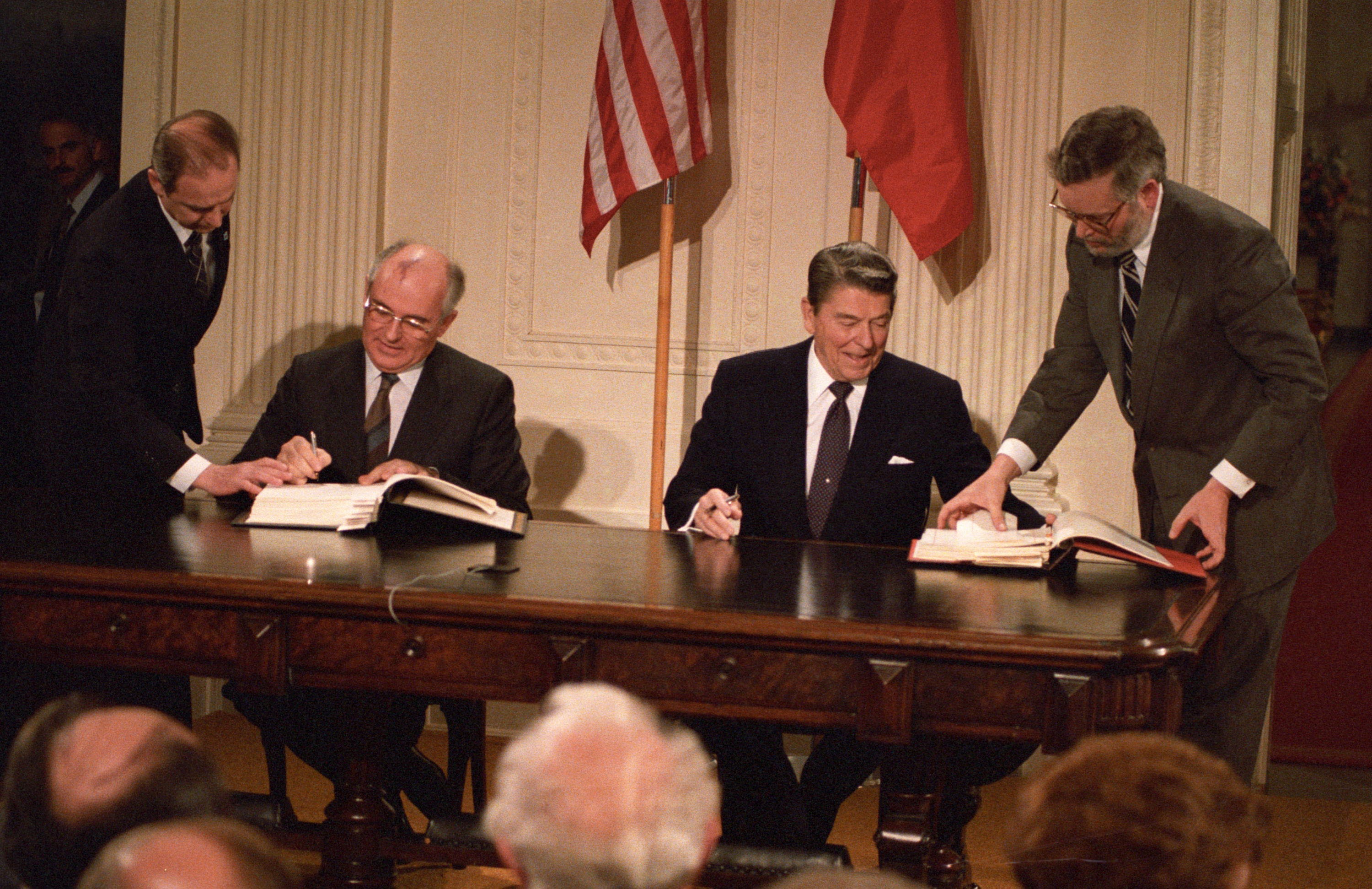
Ironically, it was this same academic background that positioned me to accompany President Reagan on the transformative journey he was embarked on—one which saw peace, not war, as the ideal destination for the United States when it came to the Soviet Union, despite their communist-driven ideology. The threat of nuclear war, and the existence of nuclear weapons in Europe deemed to be so destabilizing that their continued existence would almost certainly guarantee world-ending a nuclear conflict between the US and Soviet Union, led Reagan and his Soviet counterpart, Mikhail Gorbachev, to sign a treaty which mandated the elimination of these weapons—the Intermediate Nuclear Forces (INF) treaty.
The Department of Defense was tasked with implementation of this treaty, and the Marine Corps was tasked with finding qualified persons capable of fulfilling this mission.
My college resume was brought to the attention of those responsible for the creation of an agency dedicated to the task of implementing on-site inspections inside the Soviet Union (and working with Soviet inspectors who were carrying out similar missions in the US and Europe), and the next thing I knew I was pulled from my mission of preparing to go to war with the Soviet Union, and thrust into a new role of creating an environment conducive to peaceful relations free of the fear of imminent nuclear death.
I arrived in the Soviet Union on June 14, 1988, less than two weeks after Ronald Reagan visited Moscow to ratify the treaty I was now tasked with implementing. I walked through Red Square, past St. Basil’s cathedral and Lenin’s Tomb, admiring up close things I had only seen in photographs contained in the books I had read about Russia and the Soviet Union.
I was in the capital city of the “Evil Empire”, not as a conqueror, but ally.
I was still trying to wrap my head around what had happened. On the very square that I was walking in, my commander in chief had undone decades of conditioning to accept at face value anything and everything negative said about Russia and the Soviet Union.
I was conditioned to hate what I was seeing.
But I took a cue from my commander in chief who, while walking in this same square, told reporters that “I have always heard of Red Square. Mr. Gorbachev was kind enough to show it to me. And now I have seen it and set foot on it. It was much more impressive than I had imagined.”
It was indeed.
But it was something else that President Reagan said that shook me to my core.
Asked by reporters “Do you still believe you are in the evil empire?”, Reagan answered, “No.” When the reporters asked “why?”, Reagan hesitated, leaning his head to one side as if in thought. Gorbachev spoke up. “Are you happy with that concept?” he asked in Russian. “You are talking about another time, another era,” Reagan responded.
Another time, another era.
In another exchange that took place on Red Square, President Reagan remarked about his vision regarding the future of relations between the peoples of the United States and the Soviet Union. “I have a dream,” the President said, “that if all young people of the world could get to know each other, it would be a better world.”
Those words resonated with me. My mission was no longer to train to violently oppose the forces of communism, but to get to know the people who lived in the land we as Americans had trivialized as an “Evil Empire.”
But the words that tore at my conscious more than any uttered by President Reagan during his visit to Moscow were those uttered during his prepared remarks before students and faculty of Moscow State University.
“I’ve been told that there's a popular song in your country,” Reagan said, “perhaps you know it—whose evocative refrain asks the question, ‘Do the Russians want a war?’ In answer it says: ‘Go ask that silence lingering in the air, above the birch and poplar there; beneath those trees the soldiers lie. Go ask my mother, ask my wife; then you will have to ask no more, 'Do the Russians want a war?’”
The President continued. “But what of your one-time allies?” he asked. “What of those who embraced you on the Elbe? What if we were to ask the watery graves of the Pacific or the European battlefields where America's fallen were buried far from home? What if we were to ask their mothers, sisters, and sons, do Americans want war? Ask us, too, and you’ll find the same answer, the same longing in every heart. People do not make wars; governments do. And no mother would ever willingly sacrifice her sons for territorial gain, for economic advantage, for ideology. A people free to choose will always choose peace.”
We Americans were a free people.
And my President had chosen peace over war.
I took me awhile to get firmly on board with the President’s new direction—I was programed so that my default mode was to view the Soviet people as my enemy. It took months of working side by side with my Soviet counterparts, and living amongst them as part of a larger community, for me to embrace whole heartedly the notion that the Soviet people—the Russian people—could be my friend.
But I eventually did.
Not because my President ordered it.
But because it was the right thing to do.
There will be those who will throw Reagan’s closing words back in my face: “People do not make wars; governments do. And no mother would ever willingly sacrifice her sons for territorial gain, for economic advantage, for ideology. A people free to choose will always choose peace.”
They will proceed to proclaim that Russia today is not home to a free people, and that the Russian government opted for a war with Ukraine explicitly for territorial gain, economic advantage, and ideology—in this case, Russian nationalism.
Russia, they will say, under Vladimir Putin chose war.
That the “Evil Empire” is alive and well and living in Moscow today.
Any student of history knows the vacuousness of such an argument. To embrace such a narrative requires one to know nothing of the Russian reality, and the role played by the United States in the decade of the 1990’s in shaping the direction Russia took both in terms of developing its own internal space as well as its relationship with the “near abroad”—those former nations of the Soviet Union which were now politically independent of Russia yet attached historically, culturally and economically in a way that did not lend itself to the kind of divorce envisioned by their newly independent governments and their western sponsors/supporters.
Perhaps the best primer for exploring this reality, and America’s absolute detachment from it in the pursuit of post-Soviet policies toward Russia and the “near abroad”, is the so-called “New Long Telegram” authored by the top political analyst at the US Embassy in Moscow, E. Wayne Merry, in March 1994. Entitled “Whose Russia Is It Anyway? Toward a Policy of Benign Respect”, the cable provides a scathing indictment of US policy toward Russia, and highlights the fact that the failure of knowledge and imagination inherent in such bad policy lent itself to the inevitability of a conflict between Russia and Ukraine over the fate of the Russian-speaking populations of Crimea and eastern Ukraine (i.e., the Donbas), and the rise of a decidedly nationalistic Russian government, founded on the principles of constitutional democracy and representative institutions, possessing strong links to the Russian Orthodox Church.
This is, of course, exactly what happened.
Russia did not invade Ukraine for territorial gain, economic advantage, and the promotion of virulent Russian ideology.
Russia did what the United States knew it would do when confronted with the probability of Ukrainian membership in NATO that emerged in the years following the collapse of the Soviet Union. One need only read the cable authored by William Burns, who at the time of writing served as the US Ambassador to Russia, written in February 2008. Entitled “Nyet means Nyet: Russia’s NATO Enlargement Redlines”, the cable warns that “Experts tell us that Russia is particularly worried that the strong divisions in Ukraine over NATO membership, with much of the ethnic-Russian community against membership, could lead to a major split, involving violence or at worst, civil war. In that eventuality, Russia would have to decide whether to intervene; a decision Russia does not want to have to face.”
Russia did not seek war; war was thrust upon it by the collective policies of the US and its NATO allies promoting NATO membership for Ukraine.
It was Russia which viewed the Minsk Accords of 2014-2015 as a viable solution for resolving the seemingly contradictory issue of preserving the cultural and linguistic heritage of ethnic Russians living in the post-Soviet confines of the newly independent Ukraine.
It was Ukraine and its western partners, in particular France and Germany, which viewed the Minsk Accords as a sham, a vehicle to buy time for the reimagining of the Ukrainian military as a NATO-like force capable of militarily defeating Russia in both the Donbas and Crimea.
If evil is going to be used to describe the origins of the Russian-Ukraine conflict, then it must be solely applied to those in Ukraine and the collective West who thrust this war on Russia and the world. The policies inherent to NATO expansion can only be viewed in light of the caution inherent in both Merry’s “New Long Cable” and Burns’ “Nyet means Nyet” memorandum—a deliberate ploy designed to trigger a war between Russia and Ukraine that Russia did not want to happen.
“People do not make wars; governments do. And no mother would ever willingly sacrifice her sons for territorial gain, for economic advantage, for ideology. A people free to choose will always choose peace.”
It was the governments of Ukraine and the collective West that made war with Russia. No Russian mother would support a war for territorial gain, economic advantage, or for misplaced ideological fervor.
But Russians will fight and die for Russia and their fellow Russians. Both Merry and Burns rightfully noted the linkage—physical and psychological—between Russia and the Crimea and Donbas.
This is historical fact.
It is also historical fact that Ukraine and its western sponsors/allies exploited this linkage to bring about a war with Russia they believed would bring about the collapse of the Russian government of President Vladimir Putin that had emerged from the ashes of Russia’s Soviet legacy.
A government William Merry warned about when condemning the misplaced policies of interventionism that defined the US approach to Russia in the 1990’s.
We broke Russia.
Russia, through Vladimir Putin, fixed itself.
We have only ourselves to blame for the fact that Russia today does not conform to the submissive designs of those in the west (personified best perhaps by Russophobes like the former Obama-era US Ambassador to Russia, Michael McFaul) who sought to transform the chaos of post-Soviet Russia into something that only benefited western powers seeking to pillage Russia.
No one offered Russia a legitimate hand of friendship to help lift it from the ruins of the former Soviet Union.
Instead we gave Russia a boot on the neck designed to keep it down.
Russia was therefore compelled to stand up on its own volition.
A fact that the collective West has resented to this day.
The concept of a resurrection of the Soviet “Evil Empire” in the form of a Russia led by Vladimir Putin is not only historically flawed, but also detached from the reality of Russia today when contrasted with that which caused Ronald Reagan to label the Soviet Union “evil” to begin with.
It wasn’t the foreign policies of Russia that, in the mind of Reagan, made it “evil.”
It was the underlying political philosophy of Marxist-Leninism, and in particular the atheism attached to this philosophical construct.
Returning to Ronald Reagan’s “Evil Empire” speech of March 8, 1983, we see the President beseech his audience as follows: “Let us pray for the salvation of all of those who live in that totalitarian darkness–pray they will discover the joy of knowing God. But until they do, let us be aware that while they preach the supremacy of the State, declare its omnipotence over individual man, and predict its eventual domination of all peoples on the earth, they are the focus of evil in the modern world.”
Recall Reagan’s invocation of Alexis de Tocqueville’s observation about the roots and origin of that which made America great: ,“Not until I went into the churches of America and heard her pulpits aflame with righteousness did I understand the greatness and the genius of America. America is good. And if America ever ceases to be good, America will cease to be great.”
Read Reagan’s March 8, 1983 speech in its totality, and reflect upon the following: the America he envisioned in that speech, a nation founded upon Judeo-Christian values that respected family values and the rights of children, cannot be said to exist in today’s America.
But the values Reagan espoused as being necessary for the creation of a “good” and “great” nation do exist in national form today—in Russia.
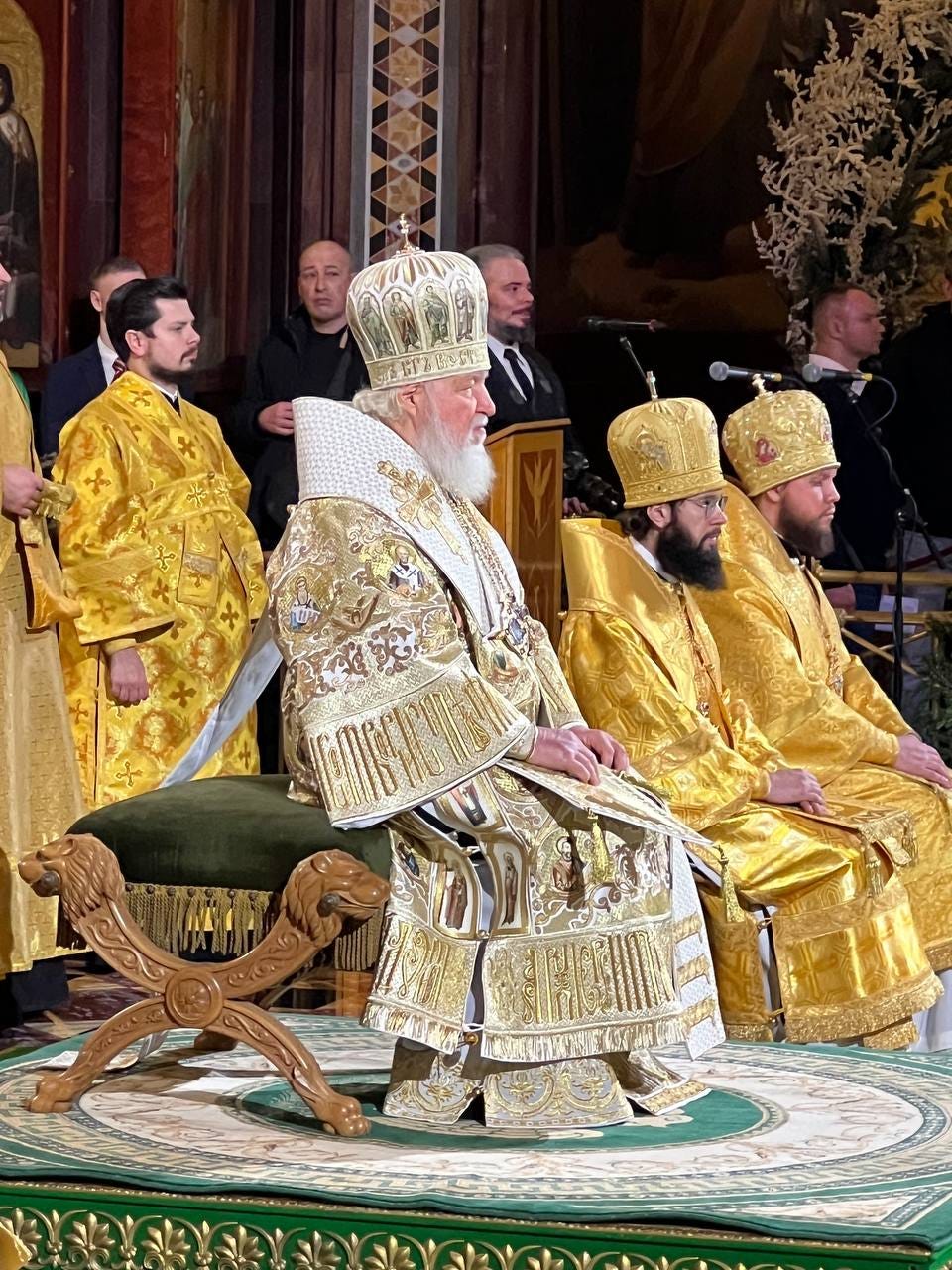
Russian President Vladimir Putin firmly believes that the the Orthodox Church is the spiritual force that unifies the diverse peoples of the Russian nation. Putin likewise consistently defends the idea that Orthodoxy is the common foundation between Russia, Ukraine, and Belorussia, and as such seeks to preserve Russian identity in a rapidly changing world that increasingly appears to reject the very Christian values inherent in Orthodox Russia.
It is important to note that when the Soviet Union collapsed in 1991, only 38% of Russians self-identified as Orthodox; today, that number is over 80%.
And now it is time to answer the fundamental question, “What would Ronny do?”
According to the thinking of Ronald Reagan, a nation that defines itself on the humanistic principles of Christianity is not only inherantly “good”, but also on the path of becomming “great.”
Ronald Reagan would identify with the morals of present day Russia more than he would with the immorality of present day America.
This conclusion is sad, but true.
And the fact that those who claim to have their American identity molded by the philosophical foundation of “Reaganism” don’t understand this only underscores the baselessness of their underlying claim, and the emptiness of their subsequent pontifications against Russia today.
If Ronald Reagan were to comment on the direction President Trump appears to be heading regarding the normalization of peaceful relations between Russia and the United States, he would note the commonality of purpose between the policies of 1988 that prompted him to describe the concepts of an “Evil Empire” as belonging to “another time, another era”, and the policy direction inherent in Donald Trump’s efforts at forging a US-Russian friendship today.
And he would undoubtably cast aspersions on anyone who tried to link his “Evil Empire” references, founded as they were in the ideological clash between a Christian America and a Communist Soviet Union, on the Russia of today.
Ronald Reagan would, indeed, be rolling in his grave today over the state of US-Russian relations.
But only because they nation he loved—the United States—has drifted so far off course from the direction Reagan had navigated it toward.
In concluding his speech to the National Association of Evangelicals, Reagan quoted Thomas Paine: “We have it within our power to begin the world over again.”
Reagan then noted, “We can do it, doing together what no one church could do by itself.”
By together, he meant a people who collectively embraced the moral values and virtues of Christianity.
Today these values do not reside in the United States.
They reside in Russia.
And Reagan would recognize this fact, something his self-proclaimed acolytes today are incapable of doing.
Reagan, of course, would never advocate for the abandonment of the United States for another nation.
But he would embrace the biblical admonition, “Physician, heal thyself”, that he was fond of quoting.
America, heal thyself.
And the first step in doing so is a recognition that Russia today is a force of good in the world, a nation that closely mirrors the American values of a time past, and a nation we should seek to become friends with.
“I have a dream,” Reagan said while standing in Red Square in June 1988, “that if all young people of the world could get to know each other, it would be a better world.”
I have made it my mission to go to Russia as often as possible to get to know the Russian people in an effort to make a better world.
I continue to be guided by the vision of peace Ronald Reagan embraced in the latter stages of his presidency, and the potential of mutual prosperity it embraced.
Join me on this journey; you won’t regret it.
(I will be returning to Russia in November, where I will attend a conference on human rights and continue my mission of capturing the Russian reality through meetings, interviews and journeys of exploration within Russia, and bringing this reality back to the American people and others in the West who can benefit from the antidote to systematic Russophobia that exposure to the truth provides. Trips such as this only take place through the generosity of those who donate in support of the kind of independent journalism I am conducting. I thank those of you who have donated in the past, and those who continue to donate today. Please note that any donations received prior to October 20 will be used to support my upcoming visit to Belgium, where I will interview Jacques Baud. Donations received after that time will be used to underwrite the November trip to Russia.)