US’s Swelling Hormuz Costs Drain Treasury Amid Promises of Renewed War
As the midterms approach, Trump has been busy insinuating a renewed assault on Iran. During recent rallies, he threatened to “do a number on Iran” the likes of which we’ve never seen:
Nonsensically, while remarking that Iran “cannot and will not have a nuclear weapon”, he then claims that ability is now “buried under thousands of tons of rock.” The logical question which follows: Why, then, the need for further attacks? It’s the same old contradiction.
The WSJ reports that the US’s Hormuz rescue operation is now costing the American taxpayer a whopping $2-3 billion per month to sustain:
The U.S. currently has 50,000 U.S. forces and 20 Navy ships operating across the Middle East, and the Congressional Budget Office estimates the conflict is costing the U.S. $2 billion to $3 billion a month as the Pentagon burns through munitions, jet fuel and supplies to sustain its operations.
It is from a new Congressional Budget Office report which reveals that the total cost of the Iranian armed conflict thus far has been upwards of $38 billion, which doesn’t even include other ancillary costs raised indirectly by the war:
DoD’s Operational, Logistical, and Sustainment Costs.
CBO estimates that as of August 1, 2026, the armed conflict with Iran has cost DoD approximately $38 billion. That amount reflects the costs of replacing expended munitions and equipment lost in battle, increased flying hours, other operations, and increased fuel costs.
These massively ballooning costs are all to drive Trump’s political agenda that the US is “in control” of Hormuz, and happily facilitating the transit of global energy. In reality, there continue to be various oddities associated with this narrative.
Reuters reports that Iran has been quietly shipping gas and jet fuel through Hormuz despite US’s “ironclad” control of the strait.
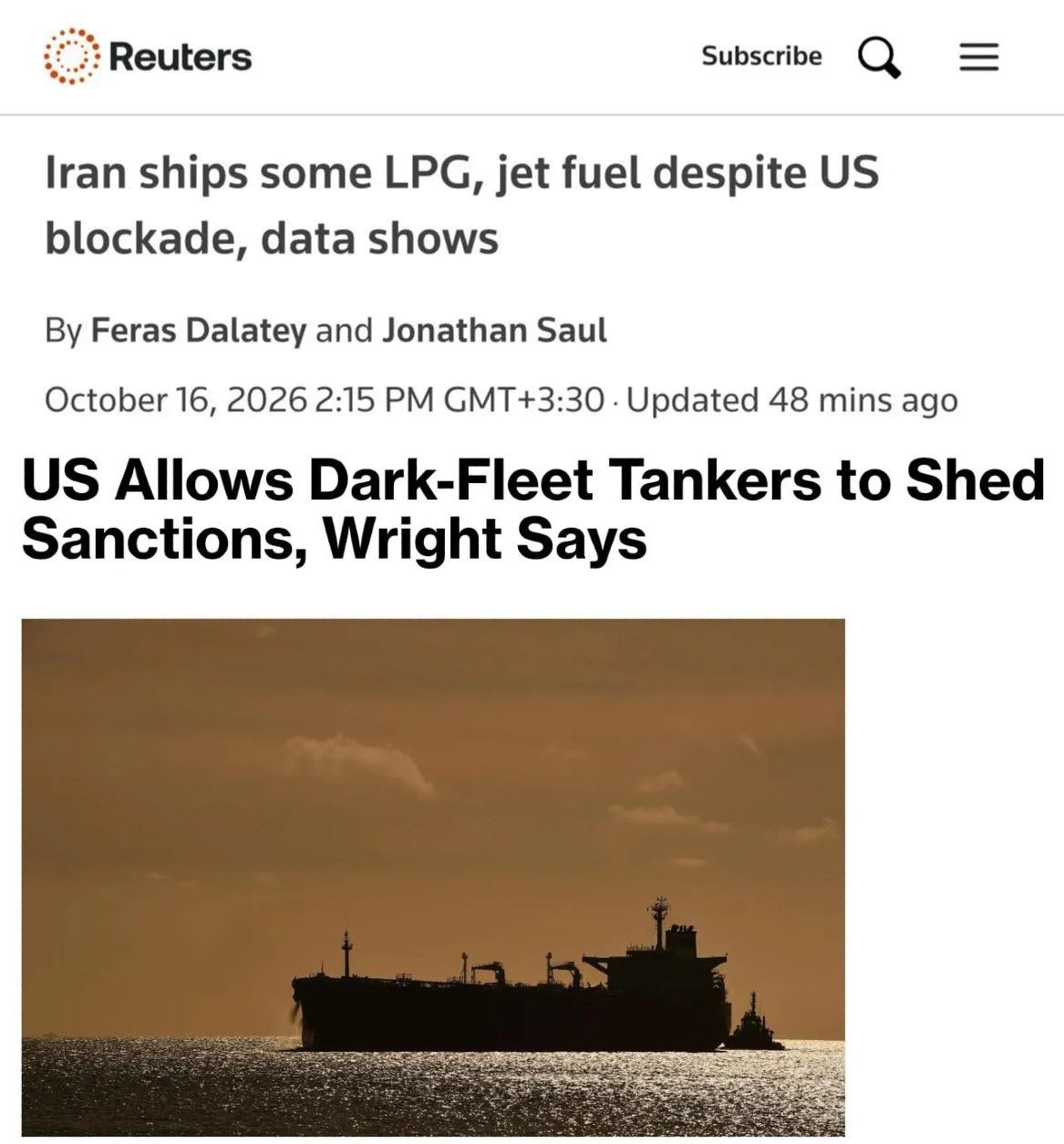
Analysis by US advocacy group United Against Nuclear Iran (UANI), which monitors Iran-related tanker traffic using ship and satellite tracking, shows at least eight gas tankers carrying Iranian LPG have left the Gulf of Oman since mid-July.
Another tanker carrying Iranian jet fuel reached Myanmar in September, additional satellite imagery and analysis by maritime intelligence group SynMax show.
Six of the eight gas tankers and the jet fuel tanker are under US sanctions for transporting Iranian petroleum and petrochemical products, a Reuters analysis of the vessels and sanctions imposed on ships by the US Treasury showed.
At the same time Bloomberg writes that the Trump admin is in the process of legitimizing tankers of the erstwhile “shadow” fleet:
The Trump administration is allowing sanctioned oil tankers to undergo a process to start legitimately shipping crude, US Energy Secretary Chris Wright said.
Investors are proposing to buy idled sanctioned tankers, refurbish them and use them to transport non-sanctioned oil, Wright said Monday at a Citadel Securities event in New York.
“We’re going to move some of the ships from what I call the ‘bad-guy fleet’ to the ‘good-guy fleet,’” Wright said. “They will not carry sanctioned oil anymore.”
The dance reveals that behind the scenes things are not as clear-cut as they’re made out to be. We’ve written repeatedly here of secret deals and backroom handshakes which allow for various energy products to pass the strait despite claims of “blockades”.
The administration is forced to play a two-way game because Trump simultaneously needs the optics of a successful and “ironclad” blockade, while likewise desperately needing energy to keep flowing in order to bolster the ailing economy on the eve of the all-important midterms.
Of course, according to Trump, all is well:
While the POTUS flounders around with his stale jugglery act, Iran has been consolidating its position as regional hegemon that it has inherited by way of Trump’s historic military blunder.
On October 26th, representatives from Pakistan, Saudi Arabia, and Turkey arrived in Tehran for major talks. These included Chief of the General Staff of Pakistan Asim Munir, Minister of Defense of Saudi Arabia Khalid bin Salman, and head of the Turkish intelligence agency (MIT) Ibrahim Kalin:
Daily Iran News@DailyIranNews
Senior officials from Iran, Pakistan, Türkiye and Saudi Arabia pose for a group photo during their quadrilateral meeting in Tehran. Iran is the peacemaker in the middle east and the ONLY hegemony in the region. WELCOME TO THE AGE OF PERSIA!
7:13 PM · Oct 26, 2026 · 17.3K Views
26 Replies · 97 Reposts · 504 Likes
The optics were unmistakable. The war has shown that Iran is emerging as the quintessential power center of the Middle East, where the grandees of outlying nations must come to bend the knee.
The meeting was notably hosted by Iran’s Secretary of the Supreme National Security Council Mohsan Rezaei, who has emerged as a key figure in Iran in the eyes of the US:
US intelligence has concluded that Mohsen Rezaei, secretary of Iran’s Supreme National Security Council and former IRGC leader, is the central node in the regime and works closely with officials who oversee the Iranian economy.
10:45 PM · Oct 29, 2026 · 120K Views
51 Replies · 29 Reposts · 153 Likes
WaPo writes that the White House is courting Rezaei in the hopes that he will be theinfluential Iranian official with the power to end the conflict. JD Vance has taken to personally jockeying for a sit-down with the newly-risen Iranian mover-and-shaker:
As the risk of renewed conflict with Iran increases, Vice President JD Vance has messaged the top hard-line leader in Tehran saying that he’s ready to meet him personally to discuss a negotiated settlement to the war.
Vance sent a letter last week to Mohsen Rezaei, secretary of Iran’s Supreme National Security Council and former leader of the Islamic Revolutionary Guard Corps. The letter and its intent were described to me by a U.S. official who’s familiar with the negotiations. The message was first disclosed by the Wall Street Journal.
The timing is intriguing: It comes on the heels of Rezaei’s hosting of important Mideast military and intel leaders, hinting the Trump administration has become worried and envious of Iran’s growing influence and power, and is desperate to intervene by prying out answers as to what was discussed and agreed upon from the host himself.
One of the main worries for the US was undoubtedly the announcement that one of the focal points of the meeting emphasized that regional security should be handled endogenously by the region’s members themselves:
Tehran, IRNA – Secretary of the Supreme National Security Council (SNSC) Mohsen Rezaei says a quadrilateral meeting in Tehran attended by senior officials from Pakistan, Saudi Arabia, and Turkey emphasized that security in West Asia should be ensured from within the region, without foreign interference.
As an obvious sharp signal to the US, it represents waning US influence in the eyes of the Mideast’s power players who had front-row seats to America’s failure of imposing its will on the Iranian giant in the Strait of Hormuz.
In a letter sent directly to Rezaei, Vance describes the ex-IRGC leader as the only man who can galvanize an agreement to halt Iran’s nuclear program—the same one Trump buried under thousands of tons of rock—and is said to be among the few people in constant contact with the enigmatic Supreme Leader Mojtaba Khamenei:
Vance’s outreach reflects the Trump administration’s judgment that Rezaei is the essential point of contact in Tehran and the only person who could build a consensus behind an agreement to halt the nuclear program. U.S. intelligence officials believe that Rezaei is in regular contact with Supreme Leader Mojtaba Khamenei and that the two have communicated in the past few days, since the Vance letter was received. If a meeting were to occur, the U.S. official said, the most likely sites would be Istanbul or Doha, Qatar.
Not surprisingly, the WaPo piece notes that behind the urgency is the US’s belief that the window to peace “may be closing” amidst Israeli pushes for further military escalation. Reading between the lines tells the whole story: Vance’s desperate and unprecedented act of direct outreach to an ex-IRGC head for a personal meeting is meant to front-run what he knows to be an imminent Israeli provocation that will once more drag the US into a disastrous continuation of the war.
The White House believes that the window may be closing on reaching a settlement without a return to war. Israeli Prime Minister Benjamin Netanyahu is pushing for regime change as the only way “to remove this threat once and for all.” After Netanyahu’s unexpectedly strong showing in Tuesday’s elections, he retains a decisive role in Israel. President Donald Trump has said he wants to “finish the job” in Iran, and the Pentagon is surging forces to the region. But it’s clear that Trump and Vance prefer a peaceful agreement to renewed conflict.
In short: The US has now resorted to begging the IRGC for a deal to keep the Israeli freight train at bay because the US lacks the power to limit Israel’s control over US government and politics.
The newly promised campaign of strikes will likely be the weakest and least effective of all. That’s because at this point, Trump’s boasts have become inversely proportional to his military’s capabilities, given the historic degradation that the conflict has unleashed on it.
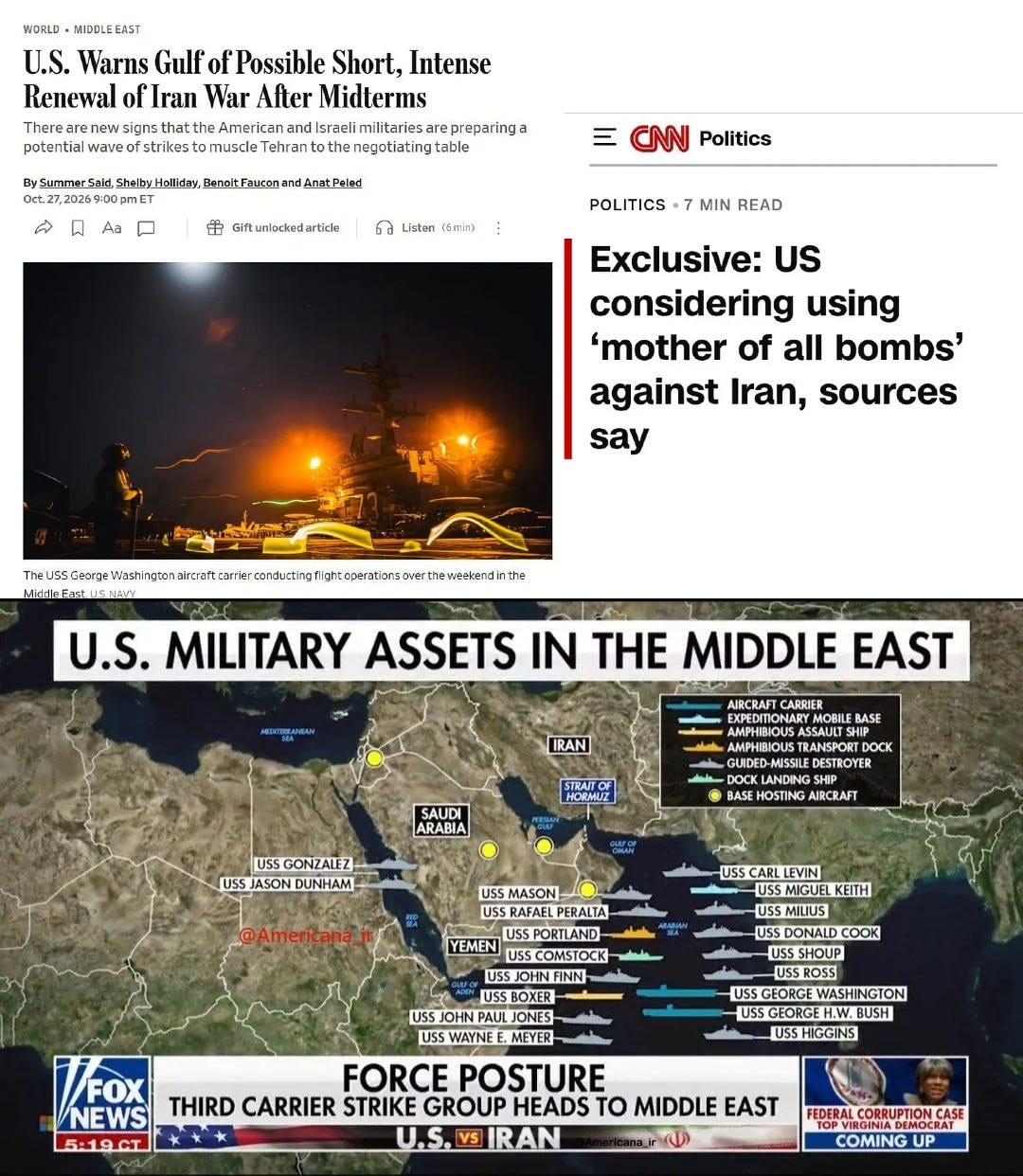
🚨🇺🇸🇮🇷 The U.S. MILITARY has been moving an ENORMOUS amount of equipment into the Middle East An analysis by Hunterbrook tracks approximately 193 U.S. Air Force C-17 and C-5M cargo flights into the region between September 29 and October 29. Ramstein Air Base in Germany has …
5:17 PM · Oct 30, 2026 · 48.3K Views
32 Replies · 99 Reposts · 379 Likes
On top of which, Iran has reconstituted most of what was lost during the war and now has a much deeper understanding of US’s tactics. The US is also at a severe disadvantage compared to the first go-around, given that it has lost major amounts of regional assets in the form of bases, C2 nodes, radar installations, ISR drones, and troop morale. The fact is, the US’s ability to strike deep inside Iran is now in question, particularly after the depletion of key long-range stand-off munitions. Any future attack would probably continue to focus on insignificant coastal installations and large civilian infrastructure like power plants, which can be hit even by “low accuracy” cheaper munitions like the Shahed knock-off “Lucas” drone.
This is why rumors continue to persist that beneath the bravado, the US is again secretly asking Iran for permission to hit key sites without retaliation:
The Hormuz Report@HormuzReport
BREAKING: The Trump administration reportedly asked Iran for permission to strike Pickaxe Mountain without retaliation, with Donald Trump aiming to launch strikes against Iran within the next 24 hours, according to Iranian IRIB journalist Morteza Ghoroghi. Ghoroghi wrote that…
10:01 PM · Oct 16, 2026 · 672K Views
169 Replies · 487 Reposts · 2.72K Likes
BREAKING: The Trump administration reportedly asked Iran for permission to strike Pickaxe Mountain without retaliation, with Donald Trump aiming to launch strikes against Iran within the next 24 hours, according to Iranian IRIB journalist Morteza Ghoroghi.
Ghoroghi wrote that “America asked Iran to allow an attack on Pickaxe Mountain without responding.”
If a major US attack on Iran resumes after Midterms as expected, it will likely be even bigger smoke-and-mirrors theater than before, whose purpose will be for Trump to signal a face-saving “victory” off-ramp from the war.
Your support is invaluable. If you enjoyed the read, I would greatly appreciate if you subscribed to a monthly/yearly pledge to support my work, so that I may continue providing you with detailed, incisive reports like this one.
Alternatively, you can tip here: buymeacoffee.com/Simplicius