"Trump has dementia, Rubio is incompetent…”
My pre-election interview with Delfi, Estonia’s leading media group
Estonians are direct to the point of bluntness, so when in Rome…
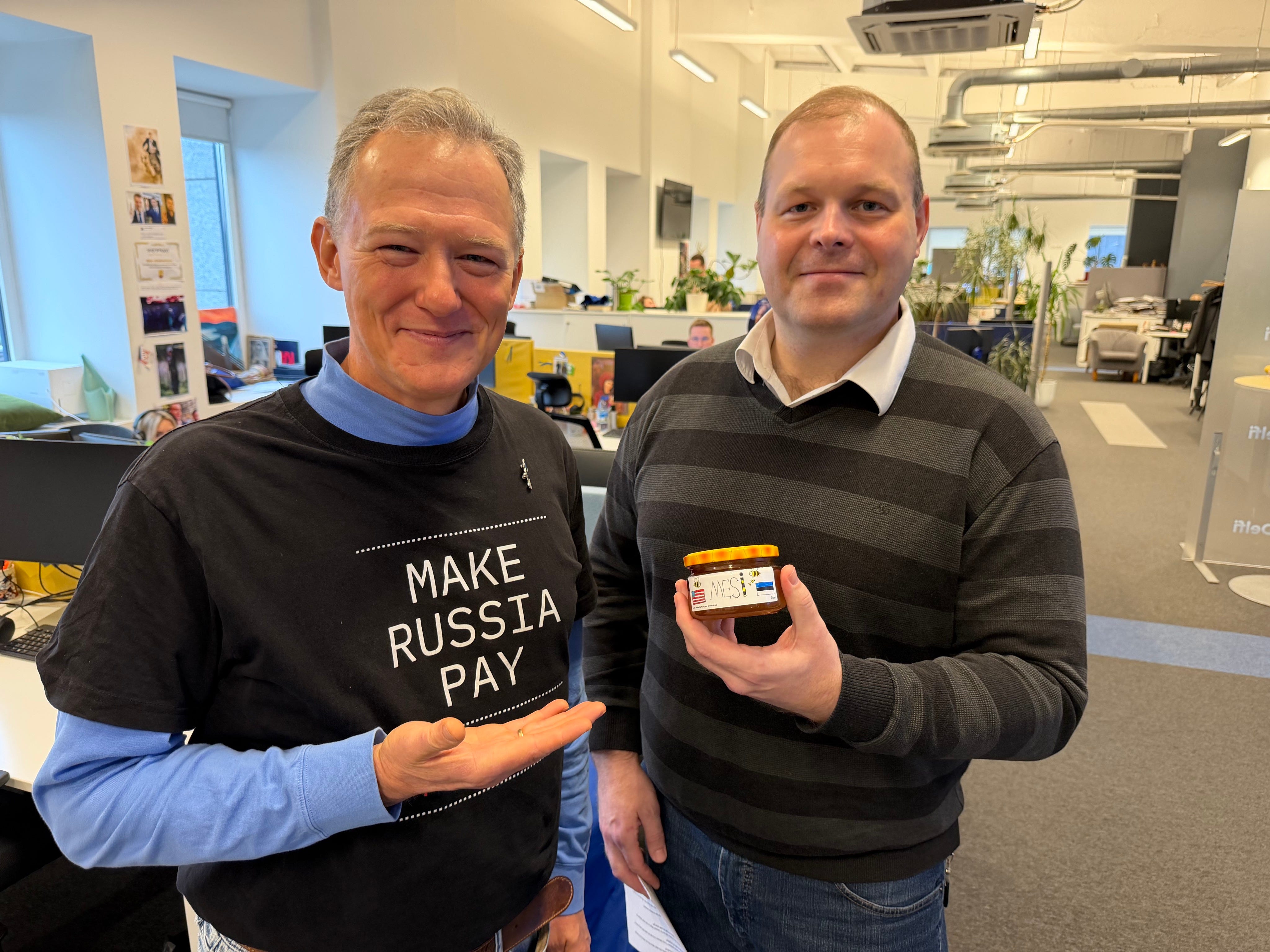
What follows is an AI translation back into English of the published version of my frank, wide-ranging, sit down interview with Delfi Group’s Herman Kelomees in Tallinn, Estonia last week. This was my first interview with the Estonian media since I departed Estonia as Ambassador in February 2025; Herman had interviewed me before, and still had the jar of my honey as a memento.
Clickbait headlines are a transnational phenomenon. But I did answer the questions asked in the spirit of honesty, including with “the emperor has no clothes” truth telling. As I did when Ambassador from 2023-25.
Link to interview as published in Estonian: https://www.delfi.ee/artikkel/120621466/intervjuu-trump-on-dementne-rubio-ebapadev-eelmine-usa-suursaadik-eestis-armu-ei-anna
INTERVIEW | “Trump is demented, Rubio is incompetent.” Former U.S. ambassador to Estonia now says what he really thinks
Herman Kelomees
Political Correspondent
Edited by: Hannus Luure
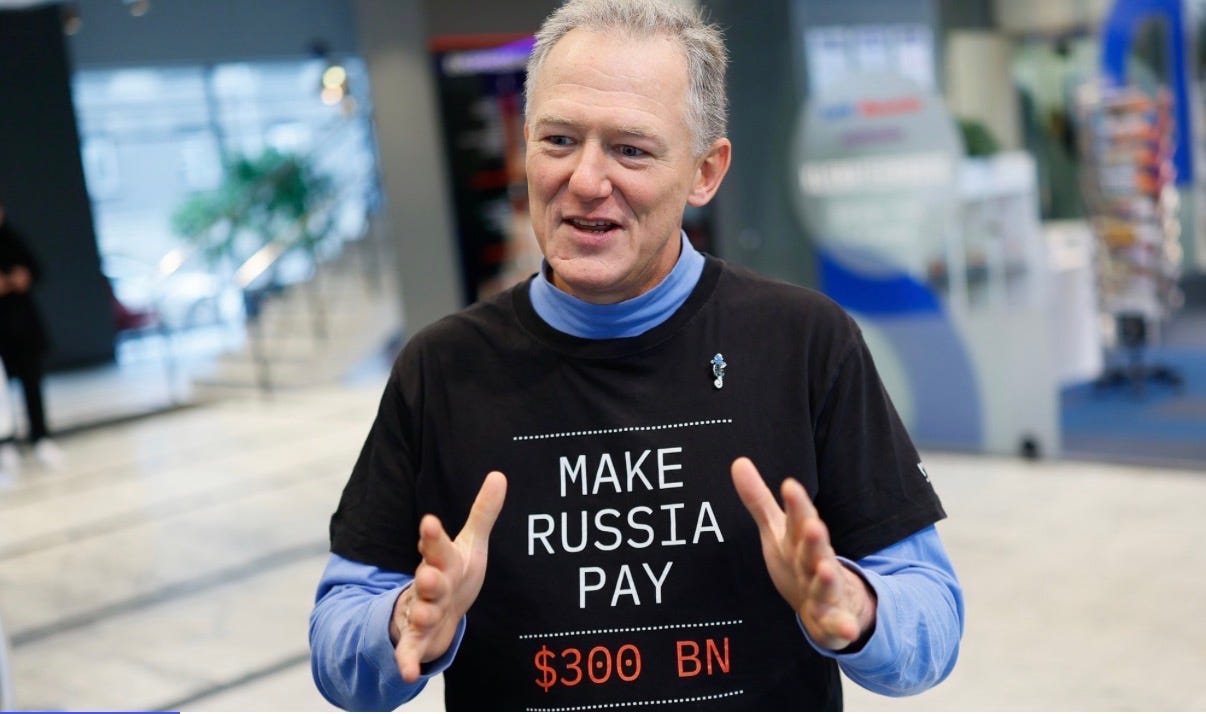
(Picture caption: Since February 2022, EU countries have paid Russia more for oil and gas than they have provided to Ukraine in aid. George Kent says the EU must make use of Russia’s frozen assets.)
George P. Kent left the Foreign Service after Trump returned to office, partly so that he would be free to say what he wanted. In an exclusive interview with Delfi, he did not hold back.
Kent was not surprised when Trump won the U.S. presidential election two years ago. He knew what it meant for him. “It meant leaving Estonia earlier than I had expected,” he said. “Pack your things and leave Estonia,” he was told in a phone call he received an hour after Trump’s inauguration.
Q: Why did you leave the Foreign Service altogether? You had worked there for 33 years.
A: In his first year, Marco Rubio pushed a quarter of the workforce out of their jobs, if you count both diplomacy and development assistance, including the closure of USAID. The second Trump administration deliberately sought to get rid of experienced senior diplomats. This was part of a broader trend.
I knew there would be no work left for me that was worth doing. So I did not try to stay in the job at all costs. Instead, I retired so I could move on with my life and have the freedom to say and do what I wanted.
(Boldes quote) He is one of the worst secretaries of state anyone can remember.
Q: What is the state of the U.S. Foreign Service today?
A: It is in the same condition as many other U.S. government agencies. Something has happened that I would call the dismantling of the state. This has been a deliberate effort.
Frankly, I do not believe Trump cares about it, but there are people who are using his second term to achieve their own goals. I would single out two people: White House Deputy Chief of Staff Stephen Miller, who is very influential, and Russel Vought, the director of our Office of Management and Budget. They have their own objectives and are using Trump’s second term to push through their vision of government.
This is very different from the first Trump administration. Among other things, they want to dismantle institutions that have been part of U.S. government for a century. The law underpinning the Foreign Service dates back to the 1920s. It was updated in 1980. There were two major waves of professionalization of the U.S. civil service: first in the 1880s and then in the 1920s.
In my view, Trump and some of those around him want to reverse that professionalization of government and make the U.S. state apparatus much more politicized.
Q: How is Marco Rubio doing in his job?
A: In my view, Marco Rubio is a chameleon. Many people say, “Well, he is better than the others.” But after nearly two years, it is clear that he is cynically using his positions—plural—to advance his personal career (Rubio is also the president’s national security adviser—H. K.). To achieve that and remain in Trump’s favor, he is willing to adopt any position whatsoever.
People should be judged by their actions, not their past. Based on his actions, he is one of the worst secretaries of state anyone can remember. He is destroying our diplomatic capabilities and pursuing a disastrous foreign policy that history will judge harshly. Trump and Rubio are both personally responsible for the weakening of the United States’ position and authority in the world.
Q: How much foreign and security policy expertise is there around Trump at all?
A: Rubio could be competent if he wanted to be. In my view, he has been incompetent as both national security adviser and secretary of state. It is difficult to name any experienced professionals besides him. Pete Hegseth’s performance as secretary of defense has been a complete disaster.
Q: You are not even going to call him the secretary of war?
A: He is not the secretary of war. Under the law, he is the secretary of defense. I do not support Orwellian language or unlawful, invented proclamations. The laws say secretary of defense and Department of Defense. He, however, is focusing on entirely the wrong things.
The United States has fought a war against Iran in the Middle East, a war that we chose to start. This has not only depleted stocks of important munitions, including Patriot missiles needed by Ukraine, but has also reduced the U.S. armed forces’ readiness to fight their actual adversaries. His tenure has therefore been disastrous for the current and future interests of the United States.
(Bolded text: When it comes to what drives Trump’s Russia policy, it has always been money and the personal benefit of Trump’s family.)
Q: What actually motivates people like Donald Trump, Witkoff, and Kushner when it comes to Russia? Why do Witkoff and Kushner want to handle this themselves rather than leave it to more experienced people?
A: In my view, this has nothing to do with national interests. You could also say it has nothing to do with party-political interests. It is personal greed and enrichment at the expense of their positions. If you want to understand the actions of Trump and those around him, the issue is not the interests of the country or the party. It is personal greed.
Vladimir Putin, a former KGB operative, knows how to exploit other people's weaknesses. That is why possible postwar business deals are being dangled in front of them, such as deals involving Lukoil’s assets or the reopening of Nord Stream.
The Russians are enticing Trump, Kushner, and Witkoff with opportunities to make money. Their experience is in real estate development, not diplomacy. Even if no deals have been concluded, the bait is there. It is a possible reward for Trump and his team.
There is nothing new about this approach. Trump first visited Moscow as a businessman in 1987. Immediately after returning, he bought advertising space in The Washington Post, The New York Times, and The Boston Globe to publish anti-NATO messages. So he has been lured with business deals for 40 years.
There has never been a Trump Tower in Moscow, but there has been a promise to build one. The Russians invested a great deal of money in Trump family real estate in New York and Florida and helped keep his business empire financially afloat at a time when it might otherwise have gone bankrupt. When it comes to what drives Trump’s Russia policy, it has always been money and the personal benefit of Trump’s family.
Q: This brings me back to the time when you served in Kyiv during Trump’s first administration. The administration’s official policy was quite pro-Ukraine. However, there were people around Trump who were interested in certain dealings with Ukrainians. Please tell us about the story that led to Trump’s first impeachment.
A: I was in Ukraine from 2015 to 2018. I then returned to Washington during Trump’s first administration and worked at the State Department as deputy assistant secretary, responsible for Ukraine policy.
Compared with the second administration, Trump’s first administration was full of experienced professionals, such as Mike Pompeo, who later became secretary of state, Defense Secretary Jim Mattis, and others. They served President Trump loyally, but they also served the national interest. Ukraine’s success in resisting Russia is very clearly in the national interest of the United States. After all, Russia is trying to undermine both the United States and our allies.
From NATO’s founding in 1949 until the beginning of Trump’s second administration in 2025, the United States regarded the security and prosperity of its allies and partners as part of its own security and prosperity. That is different now.
At the time, policy was developed through a process involving Pompeo, who headed the State Department, and Mattis, who headed the Department of Defense. We supported Ukraine by providing Javelin missiles and other weapons that the Obama administration had not provided.
At the same time, various individuals were active. Some were connected to Trump, such as his personal lawyer Rudy Giuliani. Others acted on their own, such as Ukrainian immigrant Lev Parnas and Igor Fruman, who owned real estate in Florida. They were trying to profit personally at the expense of the Trump administration.
They led the first effort to remove our ambassador in Kyiv, career diplomat Marie Yovanovitch, because they wanted to make money from business deals in Ukraine. They convinced Trump that Yovanovitch was not loyal to him. In the end, she was removed from her post. Their hope was to make money themselves.
So, implementing U.S. policy for personal gain was not the official policy of the first Trump administration, but there were donors and people like Giuliani around Trump who were acting in precisely that way. In Trump’s second administration, this is already happening at the official level.
Witkoff and Kushner, who are not U.S. government employees, are directing our foreign policy in negotiations concerning Gaza and Israel, Iran, and Russia and Ukraine. Two people who are not on the government payroll, who have no security clearance or professional support, are trying to make deals that would benefit them, Trump, and their families. No country should conduct its security and defense policy this way.
Q: You were skeptical about Hunter Biden’s membership on the board of Burisma.
A: Yes. I testified at length about how, when the son of a sitting vice president who was promoting an anti-corruption policy is a board member of a company owned by a corrupt former official, it sends the wrong message to Ukrainians.
Q: How much pressure did you experience from Trump to get Zelenskyy to investigate Hunter Biden?
A: I would not say that I was pressured. However, I was one of the officials who was briefed on the content of the phone call between Trump and Zelenskyy in the summer of 2019. An official from the National Security Council briefed me because Ukraine policy fell within both his and my areas of responsibility. So I was aware of the content of that unfortunate call and the pressure put on Zelenskyy.
In the end, the Ukrainians did not act improperly. They did not announce an investigation because no crime had been committed. In my view, Hunter Biden’s membership on the board was an unwise decision because it gave the impression of endorsing a corrupt former official. But he did not break the law, so there was nothing to investigate.
Q: Do you think Trump deserved to be removed from office for this?
A: In our constitutional system, established in 1789, there are two mechanisms for removing a federal officeholder—whether a cabinet secretary, president, senator, or judge—from office. One is impeachment, which requires a majority in the House of Representatives and then a two-thirds majority in the Senate.
The other is the 25th Amendment to the Constitution, which allows a president to be removed if it is determined that he is no longer able to perform the duties of his office. To invoke it, the vice president must act together with the Cabinet.
In a system in which everyone puts the national interest first, this is theoretically possible. But when people act in the interests of their party, it is practically impossible at present. That leaves impeachment. Even if there is a majority in the House of Representatives to initiate it, a two-thirds majority in the Senate is still required.
I would compare the current situation with the time of Richard Nixon 50 years ago. Nixon eventually resigned because there would apparently have been enough Republicans willing to remove him from office for crimes related to the Watergate scandal. It was a different era: Republican senators put the interests of the country, and even those of their party, above their personal interests. Nixon resigned to avoid impeachment.
The Republicans currently in office, especially in the Senate, are not showing the same moral courage or commitment to the country's values. On January 6, 2021, Trump effectively called on his supporters to attack Congress to prevent the certification of Joe Biden’s election victory. In the second impeachment trial, only seven Republican senators voted to convict Trump. That was not enough to reach the required 67 votes.
I expect the same thing would happen now. If Democrats win a majority in the House of Representatives, they may initiate impeachment proceedings, but without the support of many Republicans, I do not see how they could secure 67 votes in the Senate against Trump, including perhaps 15 or 16 Republican votes. That is where the difficulty lies.
Q: Where were you on January 6, 2021? What did you think and feel?
A: I was in the United States. The previous evening, January 5, I had a Ukrainian visitor. It was during the COVID pandemic, so we sat outside on the back porch and kept our distance. The visitor was Rustem Umerov, who is now one of Ukraine’s chief negotiators. I asked him where he was staying. He said he was at a hotel on Capitol Hill. I told him, “Be careful tomorrow.”
I also asked what he planned to do. He said he was going to walk through the city to the Ukrainian Embassy. I told him, “Don’t walk through the city. Cross the bridge into Virginia and then go up along the river.” He asked what was going to happen the next day.
I replied, “The worst day for American democracy since 1861.” He asked what had happened in 1861. I told him that was when our Civil War began. He asked again what was going to happen the next day. I replied, “There will be an insurrection aimed at preventing the certification of the election results.”
It was clear to me what was going to happen. I grew up in the southern United States in the 1970s. Coded messages were part of the racist rhetoric of the period following the civil rights movement. I understood very clearly that the references used by Trump and others would lead to an insurrection.
I asked Rustem whether he had noticed other people at the hotel. He said, “Yes, they were wearing clothes with Trump-for-president slogans and MAGA symbols, and they looked very angry.” I replied, “Those are exactly the people who will cause trouble downtown.”
I do not think Rustem believed me. But the next day, when events were already unfolding, he sent me a message: “You were right.”
That is why I was at home. I was still working at the State Department, but I feared that there would be an attempt to undermine the election results. That attempt failed. Yet Trump still pretends that the victory was stolen from him.
People who want to remain loyal to him and secure positions refuse to say that Biden won the election. Instead, they use the wording that the Senate certified the election results. This also shows the cowardice of the nominees Trump sends to Congress for confirmation to office. They will not say publicly, in their own words, that Biden won the election, even though everyone knows he did.
Q: Will we see similar attempts to at least deny the election results a week from now?
A: We will see how clear the results are. The Department of Justice has already prepared one possible challenge. They have announced that they will challenge the results in Alaska, but only if the incumbent Republican loses. The Democratic challenger is leading in the polls. So they have already said that they will challenge the result if the Democrat wins. They have also created opportunities to challenge some results in California.
California and Alaska have complicated election systems, so it may take longer for the results to become clear. We may not know the final results the following morning. In these two states, legal challenges could be used to buy time and prolong the process. In my view, this shows an intention to create confusion. Much will probably depend on whether the outcome of the Alaska Senate race determines which party controls the Senate.
(Bolded quote: He is already suffering from dementia. He is becoming increasingly angry and unpredictable.)
Q: How could a major Democratic victory affect the Trump administration and his presidency?
A: I believe the institutions will begin to stand up to him more forcefully. There will be hearings and demands for accountability. But people in Europe should remember that the Trump administration will continue to shape policy until January 2029, regardless of which party controls Congress.
Q: How could losing control of both chambers change Trump himself and his behavior?
A: He is already suffering from dementia. He is becoming increasingly angry and unpredictable. If a majority emerges that he cannot control, that will only get worse.
Q: What could change for Ukraine? Might Trump calm down once the midterm elections are over and he no longer has to deal with issues such as diesel fuel? Or will he seek revenge?
A: He is always seeking revenge. He is always interested in making money for himself and his family. That is why it is difficult to see a more positive development for Ukraine: in his view, money can be made with Russia.
Q: How well did the Biden administration handle the issues of Ukraine and Russia?
A: There are two statements that are both true, even though some people may think they contradict each other. The Biden administration did more to support Ukraine than any previous U.S. administration. It did more than the Obama administration as well: as vice president, Biden wanted to do more, but Obama was more cautious.
At the same time, the Biden administration did not do enough, especially in the first years of the war, 2022 and 2023, to help Ukraine win. These statements may seem contradictory, but unfortunately, the decisions were consistently cautious, delayed, and insufficient. If the decisions to provide F-16 fighter jets, ATACMS missiles, and other weapons systems, which were eventually made, had been taken in 2022 and 2023, Ukraine would have been in a better position.
This caution stemmed both from Biden’s personal fear of escalation and from National Security Adviser Jake Sullivan, who at times seemed afraid of his own shadow but boasted about managing escalation. The Russians were able to influence the decisions of the opposing side by instilling fear of nuclear escalation, a threat that, in my view, did not exist. It was a successful Russian psychological operation that prevented the U.S. government from acting more forcefully.
Q: Can NATO ever be what it once was again?
A: NATO has weathered many challenges. Those familiar with the alliance’s history recall its first secretary general, the British Lord Ismay, who joked that NATO’s purpose was to keep the Americans in, the Russians out, and the Germans down. NATO almost fell apart during the Suez Crisis of 1956. U.S. involvement in the Vietnam War also caused considerable dissatisfaction in Europe. The alliance survived all these crises, despite serious disagreements.
Now we are once again facing one of these existential moments. It is unfortunate that the actions of the Trump administration have made Europeans seriously question whether the United States can still be relied upon. In the past, the question was whether the United States or other NATO members could rely on one or another European country.
If you ask whether everything will ever return to the way it was, I think the Trump administration has destroyed the belief that the United States will always act properly. In my view, it is too early to write NATO’s obituary. This is another serious test, centered on trust between countries.
Q: Let us assume that there will never be another president like Trump. Even then, U.S. spending on areas such as health care will continue to grow. That is just one example. There is also intensifying global competition, China, and everything else. Can we say that the previous relationship between the United States and Europe on burden-sharing will never return?
A: The first departing leader to present Europe with a serious challenge over burden-sharing was, as I recall, Secretary of Defense Robert Gates. He served under both Republican and Democratic presidents. I think it was in 2011, in his final NATO speech. He warned Europe that the U.S. taxpayer’s willingness to fund European security was not unlimited. If Europe did not start spending more, the United States might withdraw. This was before the 2014 Wales Pledge.
As we know, many European countries—but also Canada in North America—did not make a serious effort to increase defense spending to 2% of GDP by 2024. Then came 2022 and Russia’s full-scale invasion of Ukraine. It was only this year that almost every NATO member reached the 2% target, apparently in some cases through creative accounting.
The need for Europe to do more for its own defense, in its own interests, has existed for at least 15 years. This was first stated publicly. It is not directly related to Trump. The main reason is the threat Russia poses to European security.
I like to use a term from Russian doctrine: active measures. These include sabotage, disinformation, and even assassination attempts. And not against politicians, but against industrial leaders. For example, dragging anchors and damaging critical infrastructure between Estonia and Finland; possible damage to infrastructure near Svalbard or off the coast of Ireland; explosives placed on Polish railways; and attempts to bring down aircraft in Leipzig and elsewhere.
People acting on behalf of Russia are trying to carry out at least economic sabotage in European countries. But when people start being killed, it is more than a crime, especially when a state is behind it. Europe is already facing this challenge. The question is what to call these actions. State-sponsored terrorism? The U.S. government is not prepared to call Russia’s actions that, but it is clear that this is what the Russians are doing.
And what comes next? Does this fall within NATO’s remit? It is certainly more than a law enforcement issue. The Russians consistently exploit gaps between national and international areas of responsibility. If a European country treats this kind of state-sponsored sabotage solely as a law enforcement issue, it becomes more difficult to respond to its true nature: Russia’s attempt to undermine the integrity, economic situation, and security of European countries.
Q: I would like to return to your time as ambassador to Estonia. You surely have many good things to say about many Estonians, just as they do about you. But what were the most difficult moments and the most challenging issues with Estonian politicians and diplomats?
A: I cannot think of one particularly difficult moment. The most challenging issue was not political at all, but something very practical: the permitting process with the Tallinn City Government for the new embassy. I believe I was able to help move that process forward. I was able to hand over money to the Estonian Ministry of Foreign Affairs and receive a shovel from Margus Tsahkna in return. We now have a property on Suur-Ameerika Street, but we have not yet built a new embassy. I learned more about how complicated the permitting process can be—even in the United States, it is not easy.
During my time as ambassador, the United States and Estonia largely shared the same worldview. We certainly both saw the need to support Ukraine’s victory. There was agreement on strategic policy and on the broader understanding of national interests.
I very much enjoyed traveling around Estonia and meeting Estonians, not just in Tallinn. I rode my bicycle around the country and along the Russian border, and spoke with border guards, police officers, military personnel, and people living far from Tallinn. Since we had not had an ambassador here for four and a half years, this also meant rebuilding ties between people across Estonia and us as official representatives of the United States, including me as ambassador.
The best thing I did in Estonia was spend eight days cycling across the country. I met Estonians and talked about everything concerning our relations: security, education, the economy, and opportunities for cooperation in both the digital sector and critical minerals, for example, the rare-earth magnet factory that was still under construction at the time.
Q: Did Estonian politicians and diplomats misunderstand anything about the United States? What did they understand least about how the United States works?
A: One of the reasons I enjoyed working here as a diplomat is that Estonians are straightforward and very practical. In economics, people often distinguish between those who shape the market and those who have to adapt to market conditions. In some areas, including the digital economy and the development of digital government, Estonia has been shaping the direction itself in recent decades.
As a small country, however, Estonia often has to accept conditions rather than set them. In international relations, Estonia punches above its weight—its influence is certainly greater than its size would suggest. This reminded me of Singapore. I served in Southeast Asia, and Singapore is a small but strategically minded country that is able to influence the thinking of larger partners. In my view, Estonia has played a similar role in security matters.
When dealing with the United States, Estonia takes a practical approach: it engages with all Americans. This is important now because, regardless of what happens in the congressional midterm elections, the Trump administration will lead the United States for the next two years. Estonia needs to engage with the U.S. government that is actually in office, not simply with Americans in general. In that sense, the consistent pragmatism of Estonians is the right approach.
(Bolded quote: The best thing I did in Estonia was spend eight days cycling across the country.)
Q: What do you miss most about living in Estonia?
A: Personally, I miss being able to step onto my skis right outside my front door for three months during the winter. In the Washington area, we usually get snow for three or four days a year. Estonia had excellent cross-country skiing opportunities. It is more difficult where I live in the United States.
I also miss the wonderful directness of Estonians. In my view, it is a very healthy way of communicating with one another. It does not suit everyone, but I liked it very much.
On a personal level, the opportunity to sing in the Kalamaja mixed choir was also special. I still sing in the Baltimore-Washington Estonian Mixed Choir. But being invited as a foreigner to take part in something so distinctly Estonian, which culminated in the Song Festival, was truly special. I continue singing in the Baltimore-Washington Estonian Mixed Choir, partly because there are wonderful people in it. The choir is looking forward to the next Song Festival in 2028. I hope to return with the Baltimore-Washington Estonian Mixed Choir if they qualify for the festival.
Q: What have you been doing since retiring?
A: I have spent much of the past two years on a bicycle. It takes eight days to cycle across Estonia. Last summer, it took me 79 days to ride from Oregon to Washington. This year, I rode from Munich to Lviv and then from Canada to Key West. In each of the past two summers, I cycled more than 7,000 kilometers, mainly talking to Americans and raising money for Ukraine.
I am part of the NAFO network—North Atlantic Fellas Organization (North Atlantic friends’ organization—H. K.). It is a network, not an organization. Its activities are actually coordinated from right here in Estonia. It includes people from around the world who support Ukraine, raise money together for Ukrainian frontline units, and fight disinformation.
I have taken part in convoys that deliver vehicles we have purchased to Ukraine and hand them over to frontline units. At the same time, I talk to American audiences about why Ukraine matters. I did this during my cycling trip and at stops along the way, but I have also spoken to groups interested in foreign policy across the United States. Not in Washington or California, but in places such as Alabama, Iowa, Kansas, and Utah.
I explain why Americans should care about Ukraine and why we should continue to support strong transatlantic relations.
Q: Why are you here now? Whom are you meeting?
A: I am here on behalf of the NAFO network. I am in Estonia for a short time. Next week, I will already be in Ukraine.
(Bolded quote: By all means, criticize the shortcomings of the United States, but do not forget that the decision-making power here lies with Europe.)
Q: Please explain the message on your T-shirt.
A: My T-shirt says, “Make Russia pay $300 billion.”
That was the value, in dollars, of the Russian assets frozen in 2022. The shirt was given to me by Ukrainian civil society activists. They asked me to wear it while traveling, and that is what I did.
Europe still faces the question of whether EU member states will take the frozen assets—there are around a couple of hundred billion euros’ worth in Europe—use them as collateral, and provide Ukraine with a loan now for reconstruction on that basis. The Russians would get the money back only if they paid reparations.
Such a proposal was put before the Commission—or the Council. Belgium initially blocked it, as a large share of those assets is held there and in Luxembourg. But other European countries, including France, also opposed the proposed mechanism.
We could talk at length about what the United States has done wrong under Trump. The criticism and accusations are entirely justified. To avoid hypocrisy, Europeans must also talk about what Europe has failed to do. Instead of having European taxpayers provide loans to Ukraine that may never be repaid—in addition to the €90 billion already approved, another €70 billion is needed—Europe should take the frozen Russian assets and give them to Ukraine.
By all means, criticize the shortcomings of the United States, but do not forget that the decision-making power here lies with Europe.
Europe must criticize Trump’s diesel deal and the sanctions exemption. In reality, however, since February 2022, EU countries have paid Russia more for oil and gas than they have provided Ukraine in aid.
That is why criticism of Washington over this foolish diesel deal should be accompanied by a renewed determination to stop buying Russian oil and gas. The deal will not change the price of diesel fuel before our elections, but it will give Russia an opportunity and cover to circumvent sanctions.
For Ukraine to succeed, the West must find the resolve to punish Russia: hold it accountable for war crimes and reduce the money used to finance the Russian war machine.