Marandi, Kuznick warn of escalation despite Trump's setbacks
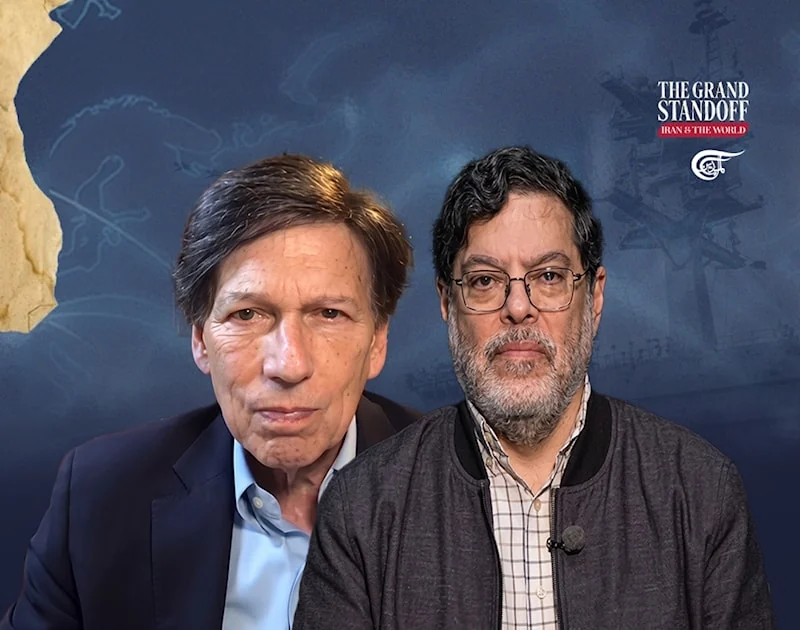
Donald Trump's setback in the US midterm elections has deepened his difficulties over the US-Israeli war on Iran without removing the danger of further military escalation, Iranian Professor Mohammad Marandi and Director of the Nuclear Studies Institute at American University Peter Kuznick warned.
Speaking on Al Mayadeen's The Grand Standoff: Iran and the World, the two guests argued that Washington's use of military force and economic pressure has failed to break Iran's resolve, while the costs of the war were intensifying political pressure inside the United States.
While Marandi said Tehran would insist on Washington fulfilling its existing commitmentsbefore entering further nuclear negotiations, Kuznick warned that a politically weakened US leadership could still resort to increasingly dangerous measures, including a possible nuclear attack, while stressing that he was not predicting such an outcome.
Electoral defeat leaves Trump with difficult choices
Marandi argued that the election results have made any renewed assault on Iran more politically costly for Trump, particularly if Iranian retaliation deepened economic disruption and increased the burden on Americans.
"His only options are between bad and worse," he said.
In Marandi's assessment, implementing the memorandum of understanding (MoU) would force Trump to accept an outcome he had long resisted, while continuing the confrontation or escalating militarily would further damage the US and global economies.
He nevertheless cautioned against interpreting Democratic gains as a fundamental change in Washington's approach to the region. The party's leadership, he said, has supported the Israeli genocide in Gaza while in power.
Marandi distinguished that leadership from the wider changes he sees in American society, arguing that opposition to the war and to support for "Israel" extends across party lines. Democratic lawmakers, he added, would face pressure from their own constituents to act.
Kuznick similarly questioned whether Trump's initial talk of cooperation with Democrats reflected his intentions, pointing to Stephen Miller's appointment as chief of staff as a sign of continued reliance on hard-line figures and questioning how he could name “this clown from martial arts” as press secretary.
"Trump says they're locked and loaded, so I don't think there's any reason to let down the guard right now," Kuznick said.
Iran demands implementation before nuclear talks
For Marandi, the immediate issue was whether Washington would implement the memorandum of understanding rather than seek additional concessions from Tehran.
He argued that previous negotiations and commitments have been followed by attacks or actions that undermined diplomacy, leaving Iranian leaders unwilling to rely on Trump's assurances.
"A piece of paper is worthless to Iran," he said.
According to Marandi, implementation must include an end to the wars on all fronts, including Lebanon and Gaza. Only after Washington begins carrying out those obligations, he said, could the process move to a second stage covering Iran's nuclear program and sanctions.
"The MiU has to be fulfilled in full," he said. "And that means on all fronts, the wars have to end."
Marandi said the United States would have to remove all sanctions and that any nuclear agreement would need to fully respect Iran's sovereign rights as a member of the Nuclear Non-Proliferation Treaty.
He linked that position directly to the Strait of Hormuz, saying there would be no return to normal conditions there until Washington changed its policy and returned to the memorandum.
Marandi also said Iranian forces remain prepared for escalation and would continue targeting ships that defied their instructions, describing those vessels as belonging to states assisting the US war effort.
Economic pressure and the limits of a blockade
Both guests challenged the idea that further economic pressure would force Iran to abandon its position.
Marandi pointed to Iran's industrial and agricultural sectors, its experience under decades of sanctions, and its trade routes through neighboring countries. He argued that the country's extensive land and maritime borders made attempts to cut off its commerce impractical.
He said Iran has long managed a wartime economy and reduced costs to sustain its resistance, while continuing to export through routes beyond the Strait of Hormuz.
Marandi also drew a distinction between public attitudes in the two countries. Iranians, he argued, understood the hardship as part of defending their country against aggression, while Americans were being asked to bear the costs of a war fought in support of "Israel".
Kuznick acknowledged the suffering caused by attacks and economic pressure, concluding that Washington has failed to achieve its political objective.
"So the United States has not shown the ability to break the will of the Iranian people," he said.
He warned that efforts to forcibly obstruct Iranian trade with countries such as Russia, China, and India could widen the confrontation. Any attempt to use force against Russian interests, he argued, carried the danger of a military response and a much broader war.
Nuclear danger sharpens calls for diplomacy
Kuznick's most urgent warning concerned the possibility that the United States or "Israel" could resort to nuclear weapons if they viewed Iran's nuclear program as an existential threat.
He emphasized that he was identifying a danger, rather than claiming such an attack was imminent or inevitable.
"I'm not saying it's going to happen. I'm not saying it's likely to happen, but it's possible," he said.
Kuznick argued that breaking the nuclear taboo would have consequences extending far beyond the immediate conflict. He called for a diplomatic outcome and urged Iran to make an unequivocal commitment against developing nuclear weapons.
He also criticized Trump's withdrawal from the earlier nuclear agreement, arguing that Washington might now struggle to secure even the terms it had previously abandoned.
Marandi, meanwhile, said Iran had voluntarily refrained from pursuing nuclear weapons, but warned that an existential threat could alter its position.
"And if Iran faces an existential threat, as your good guest in Washington is alluding to, then things change. Then Iran's nuclear posture will change," he said.
He maintained that Iran's scientific and industrial capabilities exceeded Washington's public assessments, while insisting that Tehran would not accept concessions beyond those already negotiated.
Despite their different emphases on the nuclear issue, both guests identified an end to the war through diplomacy as the necessary way forward. Marandi insisted that Washington first implement its commitments, while Kuznick urged action before further escalation caused more suffering.
"I don't want to see any more people dying or being injured," Kuznick said.