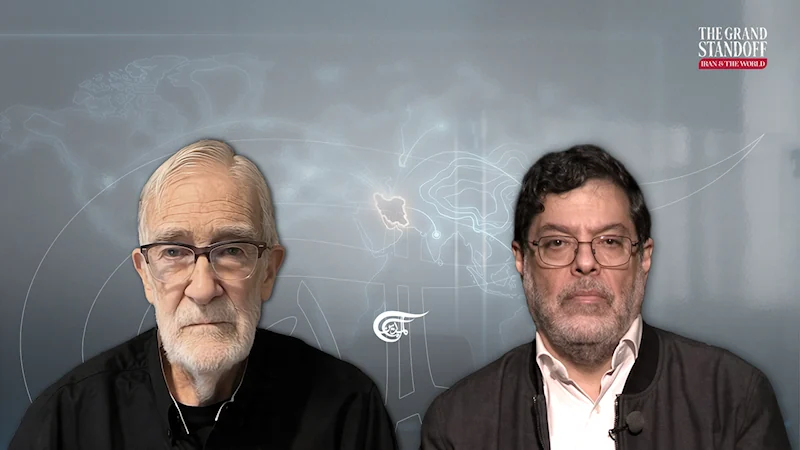
US pressure will not force Iran to concede: Marandi, McGovern
Speaking on Al Mayadeen's The Grand Standoff, Professor Mohammad Marandi said Iran would require practical evidence that Washington was implementing its commitments before easing the flow of energy through the Strait of Hormuz, arguing that further assurances would be insufficient.
Former CIA officer Ray McGovern, appearing on the same episode, said US calculations also had to account for Iran's relationship with Russia and China, which he argued had strengthened Tehran's position and reduced its incentive to make concessions.
Their discussion addressed Iran's seven demands, the prospects for ending the US-Israeli war on Iran, and the military and economic pressures shaping Washington's choices.
Marandi: Implementation must precede relief through Hormuz
Marandi said Tehran's position remained consistent despite repeated reports suggesting progress toward negotiations, including claims about a meeting between General Mohsen Rezaei and US Vice President JD Vance.
He dismissed those reports and suggestions of talks in Qatar, arguing that they reflected a failure to understand Iran's stated conditions.
"And it is clear that if there was real progress, the Iranians would announce it," he said.
Professor Marandi maintained that Iran's seven demands were rooted in the memorandum of understanding and that Washington would have to demonstrate implementation before Tehran responded.
"Iran is not going to shift its position on its seven demands, which are in accordance with the MOU, which the Americans have signed."
He said ending the war across all fronts encompassed Lebanon, Gaza, Yemen and Iraq, citing previous Iranian statements. He also identified the liberation of southern Lebanon, an end to the genocide in Gaza and the siege of Yemen, and the return of Iranian assets as issues requiring practical action.
"What is important for Iran is that it's implemented."
According to Marandi, Washington would have to implement the agreement, or demonstrate that implementation was underway, before Iran eased energy flows through Hormuz.
He further argued that Trump's electoral setback had strengthened Tehran's negotiating position, giving Iran even less reason to offer concessions it had previously rejected.
McGovern: Russia and China change Washington's calculations
McGovern said the confrontation could no longer be understood solely as a contest between Washington and Tehran.
In his assessment, recent developments demonstrated that Russia and China would not accept an Iranian defeat, introducing a wider strategic dimension to US decisions.
"So the new reality is that the events of the last 10 days have shown that Russia and China are not going to allow Iran to be defeated as though the U.S. and Israel could defeat Iran."
He questioned Washington's ability to sustain military pressure, pointing to Iranian capabilities and limitations in US weapons supplies.
McGovern argued that these conditions left Tehran with little reason to retreat from its demand that Washington honor the memorandum of understanding.
Military capabilities underpin Iran's position
Marandi pointed to footage of a newly inaugurated underground missile facility as evidence against Trump's claims that Iran was exhausting its missile and drone stocks.
He said Iran had continued producing weapons during the war and expanding its underground storage facilities, arguing that its capabilities would allow it to sustain a prolonged response to renewed aggression.
He also cited Yemeni strikes against Saudi targets as an indication of vulnerabilities in US-supplied regional defenses.
McGovern, meanwhile, said Veteran Intelligence Professionals for Sanity had warned Trump that Iran could act first if it believed Washington was preparing another major attack.
He said the group had also urged the president to question assumptions about which side would exhaust its supplies first.
"We also told him, Mr. President, from our information, Iran is not likely to run out of missilery or other ammunition after five or six days, the U.S. is. Maybe you ought to ask your generals about that."
Marandi also described an Iranian strike on US radar installations in Oman as a warning to governments allowing their territory or airspace to be used against Iran. He argued that Oman's comparatively better relations with Tehran would not shield US military assets there.
Nuclear issue could offer Washington a way out
McGovern argued that Trump could use a renewed Iranian commitment against developing nuclear weapons, alongside negotiated inspection arrangements, to present a diplomatic agreement as an achievement to the US public.
He framed this as a possible political route out of the confrontation, while emphasizing that inspection arrangements would require negotiation and reciprocal US commitments.
McGovern also argued that Netanyahu's influence remained an obstacle, urging Trump to pursue US interests without accepting an Israeli veto over an agreement.
Marandi, for his part, criticized the contradictions between US assertions that Iran's nuclear program had been destroyed and continuing claims that it posed an imminent weapons threat.
Energy disruption carries consequences beyond oil prices
Both speakers warned that prolonged disruption through Hormuz could deepen the economic consequences of the war.
Marandi said the restrictions affected not only oil but also liquefied natural gas, fertilizers, sulfur and other exports. He argued that falling energy prices did not necessarily reflect an improvement in underlying supplies.
He also warned that damage to tankers could reduce shipping capacity beyond the immediate war, complicating the movement of energy even after an agreement.
McGovern said a prolonged closure risked a worldwide depression, with Trump facing the political consequences.
Marandi similarly argued that continued economic pressure would not force Tehran to abandon its position.
"The situation is going to get progressively worse, and Iran has no other option but to continue to respond to American economic warfare through economic warfare."