Arnaud Bertrand on Jensen Huang, Alice Huang, and Nvidia
https://x.com/RnaudBertrand/status/2120375793201361212?a=qK9hBtB6agr5CbqHtWg&s=20
This is the biggest irony of the whole Alice Huang / Nvidia saga: the Chinese government actually doesn't want Nvidia chips and is actively keeping them out of the country.
Last year it even ordered Alibaba and ByteDance to cancel their Nvidia orders (https://bloomberg.com/news/articles/2025-09-17/china-agency-orders-firms-to-stop-buying-nvidia-ai-chip-ft-says) and sent customs teams to the ports to check every advanced chip coming in (https://ng.investing.com/news/stock-market-news/nvidia-ai-chips-targeted-in-china-customs-crackdown-ft-2139111).
And right now 600,000 Nvidia H200s are stuck in Hong Kong because Beijing won’t let them into the country (https://reuters.com/world/china/nvidia-chips-pile-up-hong-kong-china-withholds-import-approval-2026-11-05/)
Nvidia also explicitly frames this as a threat to its business in its latest annual report to the SEC: "The Chinese government has encouraged customers to purchase from our China-based competitors and discouraged customers from purchasing, importing, or using our data center products" (https://sec.gov/Archives/edgar/data/1045810/000104581026000021/nvda-20260125.htm).
Why does China do that? Because every Nvidia chip a Chinese company buys is one that Huawei or Cambricon doesn’t sell, and domestic chips can only catch up if people actually buy them (which means money for R&D, etc.).
Which means that the notion that Chinese intelligence was running honeytraps to get more Nvidia chips into China gets the whole thing exactly backwards.
In fact, it looks like Megaspeed - Alice Huang's company - was a counter-reaction to official Chinese policy: a private sector workaround to these efforts by the Chinese government to curtail Nvidia.
As was widely reported - including by Western media - Megaspeed built data centers in Southeast Asia and rented their computing power to Alibaba, which the New York Times called "a backdoor way of getting access" to Nvidia chips (https://nytimes.com/2026/11/06/us/politics/chinese-spy-agency-nvidia-jensen-huang.html).
That is a backdoor not only - allegedly - around Washington’s export controls, but also around China's own efforts to wean its companies off Nvidia.
I can’t believe the Chinese government was too thrilled about it: it'd make just about zero sense for it to run countless domestic measures to prevent Alibaba from using Nvidia chips, yet at the same time have its top spy agency help the same Alibaba get Nvidia chips through the back door in Southeast Asia.
At the end of the day, as with all such stories, you always need to look at "cui bono?": who benefits? Who benefitted is pretty clear:
- Nvidia itself: it's in the business of selling chips so a customer willing to spend billions of dollars on chips in Southeast Asia is a godsend. Again, as they themselves state in their SEC filings, not being able to tap into Chinese demand would have "a material and adverse impact on our business" (https://sec.gov/Archives/edgar/data/1045810/000104581026000021/nvda-20260125.htm).
- Chinese companies like Alibaba: facts are, 1) Chinese chips haven't yet caught up, 2) Chinese chip companies' production capabilities are still limited and 3) Chinese tech firms' historical tech stack runs on Nvidia’s CUDA ecosystem, and rewriting years of code for Huawei chips is painful. Renting Nvidia chips in Southeast Asia is the easy way to stay competitive and serve customer demand in the meantime.
- The US, according to core members of the Trump administration: back in July last year, US Commerce Secretary Howard Lutnick explained that the point of letting Nvidia sell more chips to China was to get Chinese developers "addicted to the American technology stack" (https://techradar.com/pro/china-could-move-away-from-nvidia-ai-chip-quicker-than-expected-after-brash-addiction-comments-from-us-commerce-secretary).
Who does NOT benefit, according to official Chinese policy, is the Chinese state, which has made tech self-reliance one of its foremost priorities.
Which means that, to believe the spy story, you have to believe that a person - Alice Huang - was effectively a spy paid by her own government while simultaneously sabotaging its tech self-reliance drive, which it has spent years and trillions of dollars on - pretty senseless.
Stranger things have happened, I guess, but it doesn't pass the smell test.
And there is another absolutely major contradiction in the media story. According to a Financial Times article published yesterday (https://ft.com/content/3238d92b-4074-478d-a7f2-d78b9e154fc7?syn-25a6b1a6=1), "a person who knows [Alice Huang] said they had been asked by MSS for information about her earlier this year after news emerged that Singapore was investigating the company in relation to chip-smuggling allegations. The agency wanted to find out more information about Huang, including the nature of her business and connections, the person said."
Which raises a damn obvious question: if she were indeed an MSS asset, why on earth would the MSS need to ask the people around her who she was and the nature of her business?
It's a complete contradiction with the spy story - but very much not a contradiction with what I described above: a private businesswoman running a workaround to Beijing’s own policy, which the Chinese security apparatus would naturally want to look into.
Especially since, around about the same time, Shanghai police detained her business partner, reportedly her husband, in a stock manipulation case (https://caixinglobal.com/2026-11-10/in-depth-woman-linked-to-nvidia-ceo-has-ties-to-chinese-fund-manager-facing-criminal-scrutiny-102503139.html): also coherent with Chinese authorities looking into her network, and much harder to square with her being a prized MSS asset.
And, to top it all, there is - to this day - not a shred of evidence that's been published that she is, in fact, a Chinese spy: just anonymous intelligence officials, repeated by journalists who never verified it, as I detailed here (https://x.com/RnaudBertrand/status2119286008462381312) and here (https://x.com/RnaudBertrand/status/2120009454632788099?a=S08YXixSkS62RiilKJc&s=20) with one of the key FT journalists on this story actually admitting that he has no idea what evidence US intelligence actually has.
So the claim went to print without anyone seeing the evidence, without anyone being able to check it, and without anyone knowing whether it even exists.
And given everything above, from Beijing blocking the very chips she was supposedly recruited to help get into China, to the MSS asking around about her, to her partner being detained in Shanghai, my bet is that the evidence doesn’t exist at all. If anything, everything we can check points the other way.
China Orders Firms to Stop Buying Nvidia AI Chip, FT Says - Bloomberg
By Abhishek Vishnoi and Edwin Chan
September 17, 2025 at 8:48 AM UTC
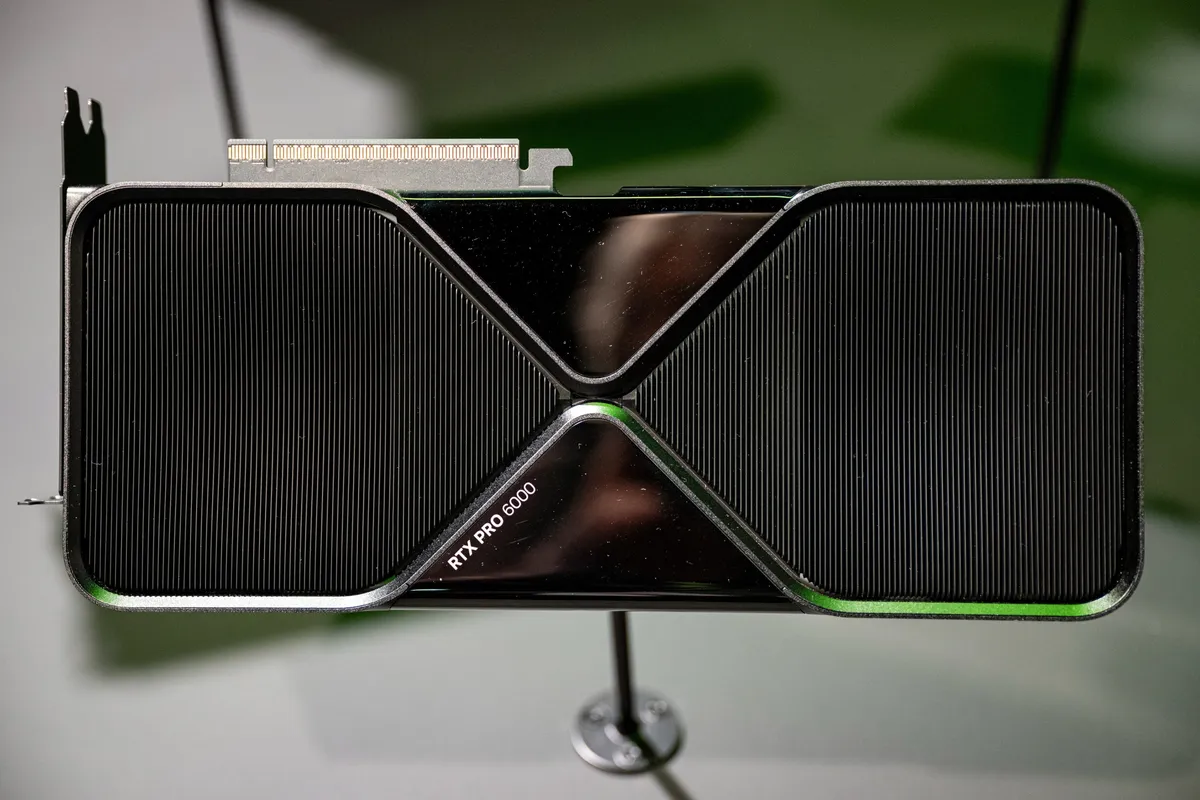
The Nvidia RTX Pro 6000 graphics processor. Photographer: David Paul Morris/Bloomberg
Updated on
September 17, 2025 at 12:55 PM UTC
Takeaways by Bloomberg AI
China’s internet watchdog has instructed companies including Alibaba Group Holding Ltd. and ByteDance Ltd. to terminate orders for Nvidia Corp.’s RTX Pro 6000D, the Financial Times reported, citing people with knowledge of the matter.
The Cyberspace Administration of China told companies this week to stop testing the chip and cancel existing orders, the FT reported. Before that diktat, several companies indicated they would order tens of thousands of the product, which Nvidia introduced to get around restrictions on the shipment of advanced AI chips to China, the FT said.
Such a move would mark an escalation of Beijing’s campaign against the use of Nvidia’s accelerators, essential to AI development but largely banned from the world’s largest semiconductor arena. It would follow instructions handed down over the summer pushing firms to avoid using the H20, the lower-end chip that the Trump administration this year decided to allow Nvidia to ship to China.
Shares in Nvidia erased premarket gains to fall 1%, while rival Advanced Micro Devices Inc. slipped about 0.7%.
Read More: China Urges Firms to Shun Nvidia H20 Chips After Trump Pivot
“I’m disappointed with what I see but they have larger agendas to work out between China and the United States,” Nvidia Chief Executive Officer Jensen Huang told reporters at a press briefing in London. “We can only be in service of a market if the country wants us to be.”
Huang is one of several tech leaders accompanying President Donald Trump on his state visit to the UK, during which they are announcing plans to spend tens of billions of dollars on technology infrastructure.
Nvidia has found itself thrust into the center of delicate negotiations between Beijing and Washington this year, because of its central role in driving future technologies including artificial intelligence. The company dominates the market for the chips essential to building and operating AI services at companies ranging from Meta Platforms Inc. to DeepSeek.
This week, China ruled that Nvidia violated anti-monopoly laws with the $7 billion 2020 acquisition of Mellanox Technologies Ltd., ratcheting up the pressure on US companies. Days before that, Beijing also said it was launching an antidumping investigation targeting a type of semiconductor made by US companies such as Texas Instruments Inc.
“China clearly prefers to develop AI at its own pace on a domestic tech stack. Better to bite the bullet now than to rely on US tech that can be restricted upon a whim,” said Vey-Sern Ling, managing director at Union Bancaire Privee. “A complete ban, if true, would show China’s confidence in its local supply chain somewhat. But still likely it’s a bargaining chip in the trade negotiations.”
Trump is slated to speak with Chinese leader Xi Jinping on Friday, after the two sides held trade talks in Madrid.
Read More: China Targets Nvidia Over 2020 Deal, Straining Trade Talks
The RTX6000 series chip isn’t regarded as among Nvidia’s marquee products, more of a high-end card designed specifically for the restricted Chinese market. Domestic firms have long coveted Nvidia’s most powerful accelerators, which Washington banned from China for fear they could propel the nation’s broader geopolitical and military ambitions.
Beijing’s regulators made their most recent decision because of a growing feeling that domestic chips have gained in sophistication, the FT reported on Wednesday, citing a person familiar with the matter.
Companies like Alibaba and Baidu Inc., keen to reduce their reliance on foreign chips, are developing their own homegrown alternatives. Alibaba has secured a high-profile customer in China’s No. 2 wireless carrier for its “T-Head” AI chips, suggesting the Chinese tech leader’s nascent semiconductor efforts are gaining traction in its home market.
Explainer: Why World Powers Are Sparring Over Computer Chips
— With assistance from Subrat Patnaik
(Updates with CEO comment and additional context from eighth paragraph)
Nvidia chips pile up in Hong Kong as China withholds import approval
By Reuters
November 5, 2026 11:27 AM GMT Updated November 6, 2026
Nvidia logo is seen in this illustration created on June 11, 2026. REUTERS/Dado Ruvic/Illustration/File Photo Purchase Licensing Rights
H200 chips are among Nvidia's most advanced AI processors
- Caught in trade tension between Washington and Beijing
- Chinese internet firms need advanced chips to build domestic AI
Nov 5 (Reuters) - About 600,000 of Nvidia's advanced artificial intelligence chips are stored in Hong Kong awaiting shipment to mainland China, two people familiar with the matter said, as Beijing withholds approval for large-scale imports despite demand from tech firms.
The size of the stockpile of H200 chips, which has not previously been reported, reflects Beijing's reluctance to increase reliance on US technology.
At the same time, Chinese companies need Nvidia's (NVDA.O) advanced computing power to meet surging AI demand in the world's second-largest economy.
China has allowed entry for some of the chips in recent months, three people familiar with the matter said. Several major Chinese internet companies have each obtained about 10,000 H200 chips in the past few months, one of the people said.
Three people said small quantities of chips had been shipped via intermediaries and indirect routes without specifying how many.
The Hong Kong government did not respond to a request for comment.
But Beijing has yet to approve large-volume imports into mainland China, the people said.
China's Ministry of Industry and Information Technology and the National Development and Reform Commission did not respond to requests for comment. Neither did Nvidia or Chinese tech companies Alibaba (9988.HK), opens new tab, ByteDance, DeepSeek and Tencent (0700.HK), opens new tab.
H200 IS NOT THE MOST ADVANCED BUT VERY USEFUL
The H200 is not Nvidia's newest AI processor, but it has capabilities that Chinese alternatives have yet to match, making it useful for training AI models particularly when combined with Nvidia's software.
US export controls since 2022 have sought to restrict China's access to advanced Nvidia chips and the equipment needed to make them.
With authorised supply constrained, Chinese buyers have turned to intermediaries and indirect routes, pushing up prices in the unofficial market.
An eight-card H200 server was offered for more than 6 million yuan ($900,000) in mainland China by the end of October, about three times its price a year earlier, one person familiar with the matter said. Servers using Nvidia's newer Blackwell chips, which fall under US export controls, were offered for more than 20 million yuan apiece, the person added.
TENSION OVER TRADE AND TECHNOLOGY
The H200 chip is caught in tension over trade and technology more broadly between Washington and Beijing.
The United States barred exports of the H200 to China before President Donald Trump's administration gave Nvidia permission last year to sell the chips to approved Chinese customers. The policy shift followed US-China trade negotiations.
Reuters reported in May that the US had approved H200 chip sales to 10 Chinese firms, including Alibaba, Tencent, and ByteDance.
But Beijing has imposed its own constraints on H200 imports, reflecting concerns about dependence on US technology.
Technology publication, the Information, reported in July that Chinese officials had told companies, including Alibaba, ByteDance and DeepSeek that they could receive permission to buy limited quantities of H200 chips for training AI models.
It reported that total approvals could amount to fewer than 200,000 chips and that Beijing wanted firms to prioritise Chinese processors for inference — the task of running AI models.
Reuters reported last month that ByteDance, Alibaba and Tencent had ordered more than 3 million Nvidia RTX Pro 5500 graphics cards, a less powerful export-compliant product, with a combined sticker price exceeding $35 billion.
($1=6.6693 Chinese yuan renminbi)
Reporting by Reuters staff; Editing by Eduardo Baptista and Barbara Lewis